Pneumatics Repair in Aviation: Best Practices to Reduce Turnaround Time and AOG Risk
Learn pneumatic repair best practices that shorten TAT, reduce parts chasing, and improve reliability — from induction to testing and engineering.
Pneumatic components are small—but their impact on aircraft availability is not.
When a pneumatic valve, regulator, or actuator fails, dispatch reliability depends on how quickly and rigorously the unit is diagnosed, repaired, tested, and returned to service.
High-performing MRO programs do not treat pneumatics as generic components. They manage them through structured processes that combine disciplined induction, standardized troubleshooting, engineering judgment, and robust test capability—ideally within an in-house or tightly integrated accessory shop.
This article explains how best-in-class pneumatic repair practices reduce turnaround time (TAT), minimize unnecessary part replacement, and protect airworthiness—and why integrated component shops create a measurable operational advantage.
What Makes Pneumatic Components High-Risk for TAT?
Pneumatic systems support critical aircraft functions, including:
Environmental control systems (bleed air distribution)
Cabin pressurization interfaces
Anti-ice and de-ice systems
Engine bleed air regulation
Selected actuation and control functions
Three characteristics make them especially vulnerable to TAT variability:
1. Hidden failure modes
Many defects are not visible externally. Internal contamination, seal degradation, or micro-cracks require structured testing to detect.
2. Dependence on test stands
Pneumatic components require calibrated, specialized test equipment to validate performance. Limited availability of test stands is a frequent bottleneck in third-party environments.
3. Parts chasing risk
Without a structured diagnostic process, repairs can devolve into sequential part replacement instead of root cause identification—extending TAT unnecessarily.
Implication for leaders: If pneumatic workflows are reactive, TAT becomes unpredictable. If they are engineered and standardized, TAT becomes controllable.
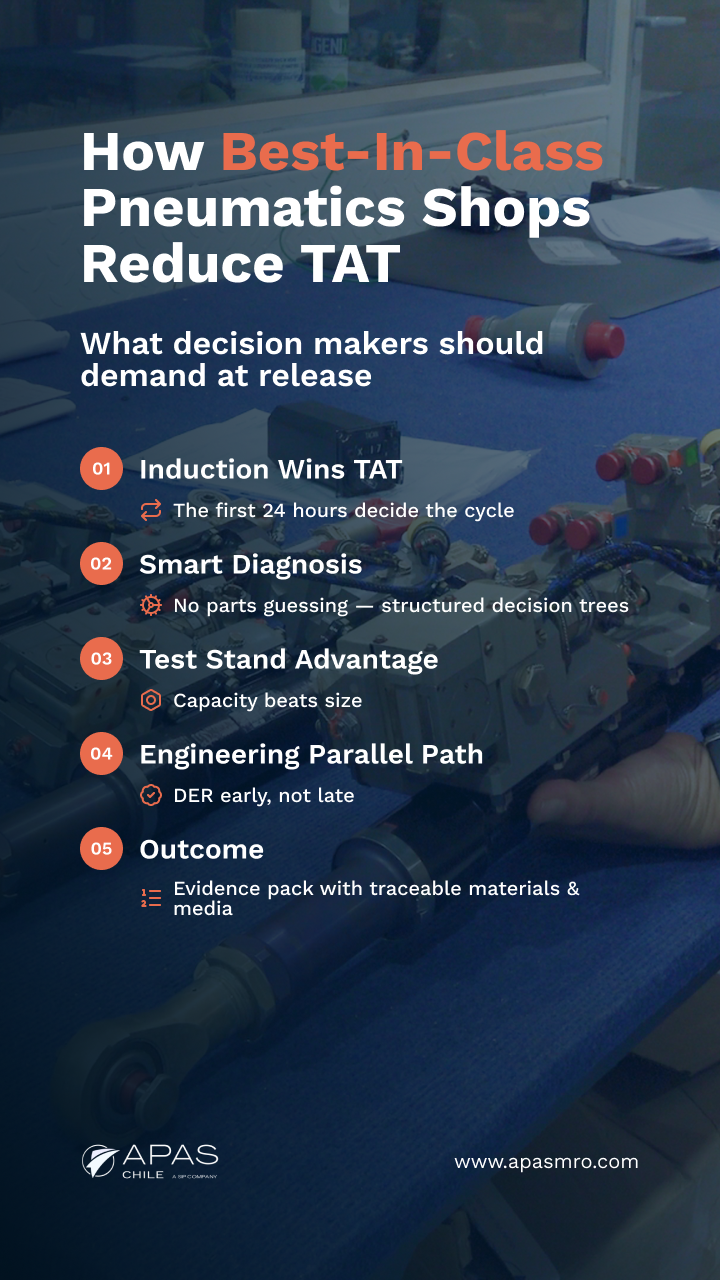
Best Practice 1 — Structured Induction: Win TAT in the First 24 Hours
In high-performing pneumatic shops, the repair outcome is largely influenced during initial induction.
A best-practice induction includes:
Serialized scan-in (PN/SN, configuration, last installation data)
Clear defect narrative from the operator (beyond “inoperative”)
This prevents generic workflows from creating avoidable delays.
Best Practice 7 — Data Visibility: From Black Box to Managed Process
Leading pneumatic shops track and communicate repair milestones:
Received → Triaged
On Bench → Awaiting Parts
In Test → Rework (if required)
Final Release
This level of visibility:
Improves planning accuracy
Reduces escalation cycles
Enables early intervention when delays emerge
Why Integrated Pneumatic Capability Reduces TAT
Operators typically see the greatest performance improvements when pneumatic repair capability is:
In-house, or
Closely integrated with engineering and logistics
This enables:
Faster triage
Immediate engineering access
Prioritized test stand allocation
Reduced total cycle time (door-to-door)
In practice, integrated models consistently improve predictability and reduce delays compared to fragmented repair workflows.
Conclusion — From Reactive to Predictable Pneumatics
Reducing pneumatic TAT is not about increasing effort—it is about improving system design.
When operators combine:
structured induction
disciplined troubleshooting
controlled test capacity
integrated engineering
They transform pneumatics from a recurring bottleneck into a controlled, predictable workflow.
At APAS Chile, the in-house accessory shop model is built around these principles—delivering faster, more consistent outcomes while maintaining full compliance and airworthiness.