How In-House Component Shops Reduce Turnaround Time in Aircraft MRO
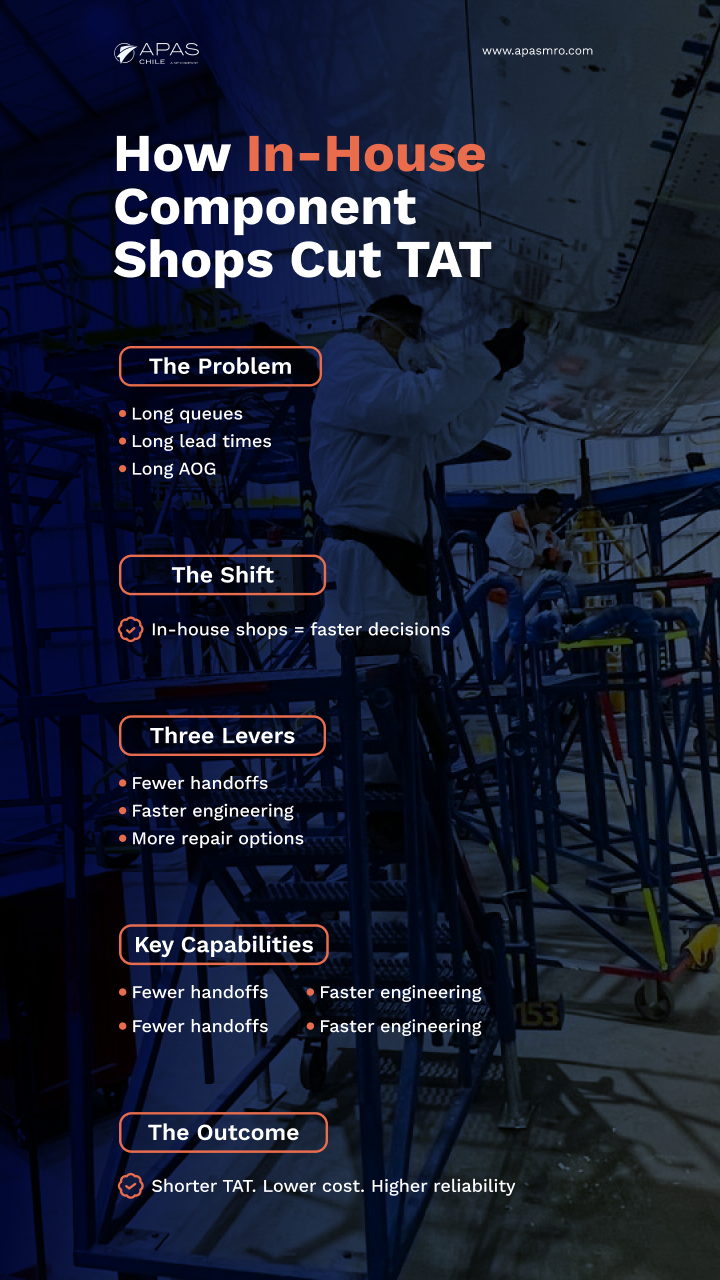
In-house component shops (pneumatics, hydraulics, composites, radomes) cut aircraft MRO turnaround time by reducing handoffs, accelerating engineering, and expanding compliant repair options.
In today’s constrained supply environment, aircraft downtime is increasingly decided at the component level — not in the hangar. In-house component shops (pneumatics, hydraulics, composites, and radomes) reduce turnaround time (TAT) by cutting handoffs, accelerating engineering decisions, and creating repair options when new parts are unavailable. When properly equipped, certified, and governed, these shops consistently shorten cycle time, lower material spend, and improve schedule predictability.
Why Component-Level Decisions Now Dominate Downtime
Aircraft Maintenance, Repair, and Overhaul (MRO) is no longer just about scheduled checks. With stretched OEM lead times, aging fleets, and tighter margins, the critical path to Return-to-Service (RTS) is often a single component.
Three layers of MRO shape outcomes:
Line maintenance – keeps aircraft flying day to day
Base maintenance – restores aircraft during heavy checks
Component-level MRO – determines how fast, how expensive, and how predictable both will be
For operators, the greatest leverage now sits at the component layer — where inspection, engineering, and repair choices directly shape TAT and AOG risk.
What “In-House Component Shops” Actually Change
An in-house component shop is not just a repair facility — it is a decision accelerator.
When key shops are integrated into your operation, you gain:
External vendors introduce inevitable delays: transport, queueing, re-inspection, and clarification loops. In-house shops reduce these transitions, compressing the overall repair timeline.
Operational impact:
Shorter door-to-door TAT
Fewer scheduling surprises
Better control of critical path items
2) Faster engineering decisions
Turnaround time is rarely lost at the bench — it is lost in decisions.
With in-house capability, engineers, technicians, and quality teams work in a single system. This accelerates:
Damage characterization
Repair vs replace decisions
Scope definition
Use of OEM, SRM, or DER-approved data where appropriate
Result: faster, better-aligned choices without sacrificing compliance.
Faster engineering decisions depend on accurate inspection and defect characterization. Techniques such as nondestructive testing (NDT) play a critical role in this phase, enabling teams to assess damage without compromising the component.
For a deeper understanding of how inspection methods support maintenance decisions, see our guide on NDT in aviation.
3) More repair options, less dependency on OEM lead times
Long OEM lead times have turned parts availability into a strategic risk.
In-house component shops expand optionality by enabling:
Targeted repairs instead of blanket overhauls
Use of approved DER pathways when OEM documents specify “replace only.”
Preservation of serviceable material
Reduced reliance on single-source supply
This is especially valuable for legacy fleets and hard-to-source components.
Where In-House Shops Create the Most Value (By Capability)
Pneumatics & Hydraulics (Accessory Shops)
These systems frequently sit on the AOG critical path.
In-house advantages include:
Faster diagnosis of seal failures, contamination, or wear
Immediate access to test stands and calibration controls
Shorter cycle time versus shipping to third-party vendors
Better historical failure tracking for reliability improvement
Typical impact: fewer repeat removals and more predictable TAT.
Composites
Composite damage often requires controlled environments, specialized tooling, and advanced inspection techniques.
In-house composites capability enables: • Rapid NDT (ultrasound, thermography, tap testing) • Controlled curing environments • Precise layup and bonding processes • Faster engineering review of out-of-limit damage
Operational benefit: shorter repair windows and reduced need for replacement.
As discussed in our article on composite materials in aviation, moving from reactive fixes to evidence-based intervention is key to reducing repeat defects and stabilizing turnaround performance.
Radomes
Radomes are mission-critical components for radar transmissivity and fleet dispatch reliability.
In-house radome capability allows:
Immediate AOG Recovery: Rapid NDT and inspection following bird strikes or lightning events.
Precision Restoration: Targeted repairs that maintain signal integrity without the "heavy" patchwork that often plagues third-party repairs.
Strategic Inventory: Reduced dependency on the volatile lead times and high costs of new OEM units.
Optimized RTS: Faster return-to-service while ensuring the unit meets all transmissivity and aerodynamic standards.
Repair vs Overhaul: Why In-House Shops Tilt the Balance
Traditional overhaul cycles often default to maximum work scope, increasing cost and TAT.
In-house, engineering-led shops enable a different approach:
Traditional Approach
In-House, Engineering-Led Approach
Blanket overhaul
Targeted, damage-specific repair
Replace by default
Repair when data supports it
Long vendor queues
Immediate bench availability
Fragmented decision process
Integrated engineering & quality
Key principle:
Better scoping + better data = better outcomes.
Compliance, Certification, and Risk Management
Speed only matters if it is compliant.
High-performing in-house shops must operate under:
FAA/EASA Part 145 controls
Approved data (SRM, OEM, or DER as applicable)
Full traceability and audit-ready documentation
Calibrated tooling and environmental controls
Qualified personnel and structured work cards
When these guardrails are in place, in-house shops deliver both speed and compliance, not one at the expense of the other.
When In-House Shops Reduce TAT the Most
In-house capability delivers maximum benefit when:
Components are frequently AOG drivers
OEM lead times are long or volatile
Workscopes require tight engineering coordination
NDT or environmental controls are critical
Repair vs replace decisions are common
Many AOG-driving components show early warning signs before failure. Recognizing these patterns early allows operators to shift from reactive maintenance to planned intervention.
This principle is especially critical in systems such as fuel tanks, where early detection can prevent operational disruption. Our guide on fuel tank maintenance in commercial aircraft explores how leaders identify and act on these signals.
Beyond TAT: The Financial Logic of Asset Utilization
While Turnaround Time (TAT) is a vital technical metric, Aviation Leaders look at the broader financial picture: Asset Velocity.
An aircraft on the ground is a capital drain. Between financing costs, lease payments, and lost revenue, the "cost of waiting" often dwarfs the "cost of repairing." In-house shops shift the focus from reactive maintenance to Capital Efficiency:
Minimized Opportunity Cost: Every day reclaimed from a third-party queue is a day the asset is back in the revenue stream.
Schedule Integrity: Faster component RTS means fewer cancelled rotations and less spend on sub-service or recovery charters.
Reduced Buffer Requirements: Higher predictability in component repair allows for leaner fleet planning, reducing the need for expensive "gap" leases.
The Bottom Line: In-house component capabilities aren't just an operational preference—they are a hedge against capital waste.
Conclusion: From Reactive MRO to Engineered Availability
In-house component shops are not just operational infrastructure — they are a strategic lever for reliability, cost control, and schedule resilience.
By minimizing logistical friction, accelerating engineering decisions, and expanding repair options, they consistently shorten turnaround time while maintaining airworthiness and compliance.