Aircraft Hydraulic Component Repair: Actuators, Pumps, Valves, and Why Testing Matters
Aircraft hydraulic component repair for actuators, pumps, and valves, why test-bench validation and contamination control matter for reliability.


Aircraft hydraulic component repair for actuators, pumps, and valves, why test-bench validation and contamination control matter for reliability.
Hydraulic power moves the parts of an aircraft that matter most: flight controls, landing gear, brakes and thrust reversers. When an actuator, pump or valve degrades, the effects ripple through several systems at once.
Reliable aircraft hydraulic component repair — backed by proper test-bench validation — is what keeps those systems responsive and dispatch on schedule.
It is a core competency of the component shops at APAS Chile in Santiago.
Hydraulic systems operate at high pressure and tight tolerances. That is exactly what makes them powerful, and exactly what makes them demanding to maintain.
Internal leakage across a worn seal, a scored actuator bore, a fatigued pump or a sticking valve can all reduce performance long before a component fails outright.
And because these parts share fluid with the rest of the system, one degraded unit can introduce contamination that shortens the life of everything downstream.
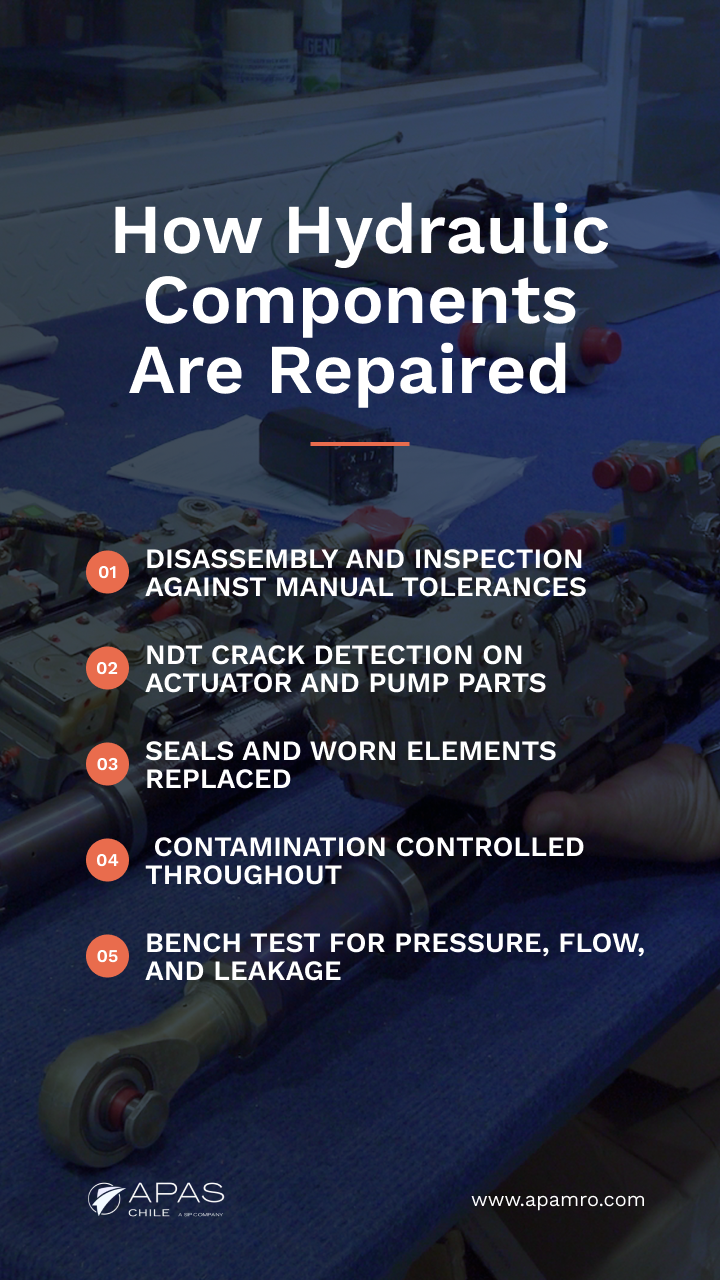
Aircraft hydraulic component repair addresses these issues at the shop level, where a unit can be fully disassembled, measured against manual tolerances, repaired, and then proven on a test bench before it returns to service.
That is fundamentally different from an on-aircraft swap. The shop confirms not just that a unit is installed, but that it actually performs to specification under representative pressure and flow.
Actuators convert hydraulic pressure into the motion that drives flight controls, landing gear and other moving structures.
A hydraulic actuator overhaul involves disassembly, inspection of the piston, rod and bore for wear and scoring, non-destructive testing where the manual requires it, replacement of seals and worn parts, and careful reassembly.
Surface condition matters enormously here. A marginal bore or a damaged rod will chew through seals and reintroduce leakage soon after installation.
Once rebuilt, the actuator is validated on a test bench for stroke, internal leakage and response — so the operator receives a unit with confirmed performance rather than an assumption.
APAS Chile's NDT methods, including fluorescent penetrant and magnetic particle inspection, support crack detection on actuator components as part of this process.
Pumps are the heart of the hydraulic system. Hydraulic pump repair focuses on restoring flow and pressure while eliminating the internal wear that causes performance loss and contamination.
Repair typically covers inspection of the rotating group, bearings and sealing surfaces, replacement of worn elements, and reassembly to specification — followed by bench validation of output pressure and flow.
Hydraulic valve testing is equally important, because valves control where pressure goes and when.
Selector valves, check valves, pressure-regulating valves and servo-controls must open, close and modulate precisely. Bench testing confirms cracking pressures, internal leakage and correct sequencing before a valve is cleared for service.
APAS Chile's component shops include hydraulic and servo-control capability, so actuators, pumps and valves can be handled together within one hydraulic system MRO workflow.
A component test bench is where hydraulic repair is proven.
It applies controlled pressure and flow that represent the component's real operating envelope, so the shop can measure internal leakage, response and pressure characteristics against published limits.
Without that step, a repaired unit is only assumed serviceable. With it, performance is demonstrated and documented.
That documentation gives the operator confidence and traceability, and it reduces the chance of an early removal after installation.
Test-bench validation also protects the aircraft from marginal parts. A unit that looks correct on assembly can still leak internally or respond slowly under load, and only a bench test reveals it.
Catching that in the shop, rather than on the aircraft, is a direct contribution to reliability.
Contamination is the most common enemy of hydraulic reliability.
Particles, moisture and degraded fluid accelerate wear, jam valves and damage seals — and they spread from one component to the next through shared fluid.
Effective aircraft hydraulic component repair therefore treats cleanliness as a discipline, not an afterthought: controlled cleaning during disassembly, protected handling of internal surfaces, and clean conditions during reassembly and test.
Controlling contamination in the shop pays off across the whole hydraulic system. A properly cleaned and validated component returns clean fluid characteristics to the aircraft and avoids seeding downstream failures.
It is one of the reasons shop-level repair adds value beyond a simple replacement.
APAS Chile brings hydraulic actuators, pumps, valves and servo-controls into one integral MRO in Santiago, supported by NDT, engineering and quality oversight, and test-bench validation.
Work is performed to the applicable component maintenance manuals under recognized certification, including DGAC Chile CMA-655 and FAA CRS APAY048E, so operators receive traceable, standards-based repairs.
Backing from SIP Holding, with its component inventory and bonded warehouse, helps keep seals, rotables and repair material available — so a hydraulic job is less likely to stall waiting for parts.
For AOG situations, that combination of in-house capability and inventory depth is exactly what an operator needs to get a critical hydraulic component back on the aircraft.
To start, contact APAS Chile and send your component and part-number details.
Aircraft hydraulic component repair involves disassembly, inspection against manual tolerances, non-destructive testing where required, replacement of seals and worn parts, reassembly, and validation on a component test bench for pressure, flow and internal leakage before the unit returns to service.
A hydraulic actuator overhaul includes inspection of the piston, rod and bore for wear and scoring, NDT where the manual requires it, seal and worn-part replacement, reassembly, and bench testing for stroke, internal leakage and response.
Hydraulic valve testing confirms cracking pressures, internal leakage and correct sequencing, so selector, check and regulating valves and servo-controls direct pressure precisely. Testing catches marginal valves in the shop rather than on the aircraft.
Contamination control keeps particles, moisture and degraded fluid out of the system. Because hydraulic components share fluid, clean disassembly, handling and reassembly prevent one unit from seeding wear and failures downstream, improving overall hydraulic system MRO outcomes.
Yes. APAS Chile's component shops include hydraulic and servo-control capability, so hydraulic pump repair, actuator overhaul and valve testing can be handled within one integral MRO in Santiago, supported by NDT, test benches and SIP Holding inventory.
Our AOG response team is standing by 24/7 to source, quote, and dispatch the components you need.
Request a Quote Now