Aircraft Ground Time: Why the Release Date Comes First
Turnaround time is agreed before anyone has seen the aircraft's real condition. Two things overrun a visit, and most operators only plan for one of them.


Turnaround time is agreed before anyone has seen the aircraft's real condition. Two things overrun a visit, and most operators only plan for one of them.
Aircraft ground time is the only commitment in maintenance that is made before the facts are available. The repair turnaround time is agreed, the slot is booked and the network plan is published while the aircraft is still flying — and the condition that will actually determine the work is not visible until it is open in the hangar. Every discipline in a maintenance visit exists to manage that gap.
That is not a flaw in how the industry works. A maintenance program can tell you precisely what has to be opened. Nothing can tell you what is behind it until it is open.
So the interesting question is not how a check is performed. It is: what actually makes a check finish on the day it was promised? The answer is narrower than most operators expect, and it is not primarily about findings.
A maintenance program is a forecast of tasks, not a forecast of condition. It says which structure to open, which systems to test, at which interval. It says nothing about what years of flying have done to a specific tail number.
That difference is the whole discipline, and it has one practical consequence worth stating plainly: the part of the visit you can negotiate is agreed before the visit, and the part that costs you days is discovered during it.
Ask an operator why a check ran long and the answer is almost always the same word: findings. Findings are real, and they explain a great deal. But they do not explain most of it.
When the industry asked its own maintenance organizations why turnaround times have been getting longer, the answer was not findings. In the joint IATA and Oliver Wyman review of the aerospace supply chain, 80% of respondents named piece-part availability as the leading cause — ahead of supply and demand imbalances, ahead of insufficient labor, ahead of OEM control of key repairs.
Read that next to how visits are usually planned and the mismatch is obvious. Operators evaluate providers on capability and price — on whether the facility can do the work. The thing most likely to stop the work is whether the part is there when the finding asks for it.
Four of those five rows are decided before the aircraft is opened. That is the uncomfortable finding of this article: by the time the finding appears, most of the schedule has already been decided.
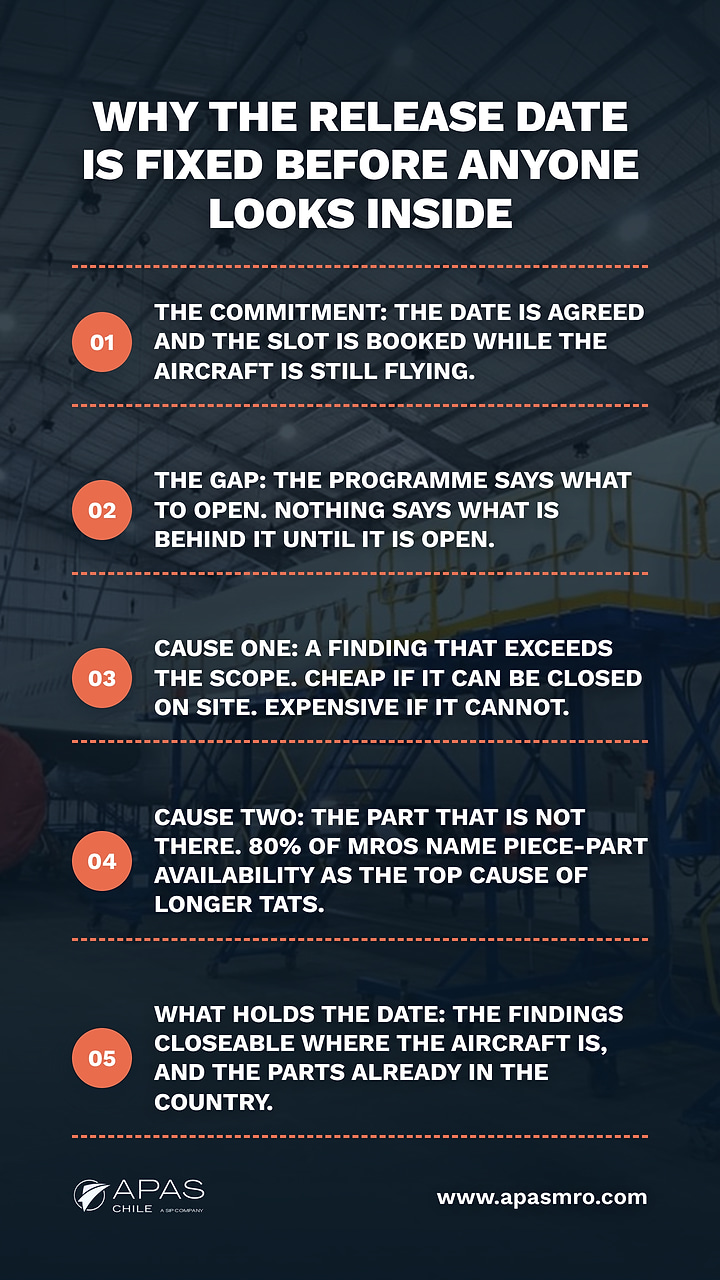
Some findings genuinely are the constraint, and they behave in a specific way: cheap while they can be closed where the aircraft is, expensive the moment they cannot.
A corrosion finding that blends out within the manufacturer's limits is a documented task. The same area, one category worse, obliges a different work package and possibly a fleet-wide obligation with a regulatory clock on it.
An engine finding has the same shape. Blended on-wing it costs a shift. If the engine has to come off, narrow-body shop turnaround times are regularly 180 to 200 days or more not a delay to a visit but a different fleet plan. Which of the two you get depends on what the finding means and what can close it.
So the finding is not really the variable. The variable is the distance between the finding and the capability to resolve it.
The second cause is the one operators systematically under-weight, and it fails differently.
A finding that needs a part does not stop because anyone lacks skill or capacity. It stops because an object has to physically arrive, be released and reach the hangar while the aircraft sits open. Where the partis held, what it has to clear, and whether that clearance was arranged in advance or is being arranged now — none of that is a maintenance question, and all of it converts into the same currency: days of aircraft on the ground.
What can be anticipated and what cannot is a longer subject; how a part actually reaches an open aircraft is where that argument is made in full. The point here is that the two causes deserve the same weight in planning, and almost never get it.
Everything above assumes an aircraft that arrived for a planned visit. An aircraft that stops unexpectedly is the same problem with the margins removed: the same two questions decide it, but there is no scoped package to absorb the work and no negotiable date to move.
Which makes an unscheduled stop a poor thing to optimise for directly. What resolves it is the capability that was already there for the planned visits — the shops, the inspection methods, the inventory near the aircraft. An operator who has those has already shortened the unplanned stop before it happened.
This is also where the difference between a heavy visit and line work stops being academic. The two run on different clocks — one in weeks, one in hours —but the arithmetic is identical. Something appears, and the only question that matters is whether it can be closed where the aircraft already is.
Turnaround time is the elapsed time between an aircraft entering a maintenance visit and being released back to service. It is agreed before the visit, based on the scoped work package — which is why findings discovered during the visit are measured against a commitment that was already made.
Because the tasks are known and the condition is not. The program defines what must be opened; it cannot define what is behind it.Overruns come from the work that was not scoped, and from waiting for partsthat the unscoped work requires.
Both, and the balance is not what most operators assume. Maintenance organizations surveyed on the aerospace supply chain put piece-part availability first among the causes of longer turnaround times, ahead of labor and capacity.
Two things, and in this order: which likely findings can be closed on site without the aircraft or its components leaving, and where the parts those findings would require are physically held today.
Ground time is not a service anyone sells. It is the consequence of decisions made before the aircraft arrived — about where the work happens, what can be closed there, and what is already on the shelf.
Which makes the answer narrower than the industry's usual language suggests. Not hangar size, not the number of production lines, not the length of the capability list. A release date holds when the likely findings can be closed in the same place as the aircraft, and when the parts those findings will call for are already in the country and already released. When either is somewhere else, the date depends on travel — of an engine, of a component, of a crate through a border — and travel is the thing nobody controls.
So the useful conversation is the one that happens before the date is committed rather than after the aircraft is open. Ask for an assessment of which findings could be closed onsite, and plan the slot against that answer — or see what a heavy maintenance visit in Santiago actually covers.
Our AOG response team is standing by 24/7 to source, quote, and dispatch the components you need.
Request a Quote Now