Corrosion on Narrow-Body Fuselages — CPCP Strategies for Operators
A corrosion finding is not one event. It is three, and each level obliges something different. What CPCP covers, what it does not, and what each level costs.
What a Corrosion Finding Does to Your Maintenance Slot
A Corrosion Prevention and Control Program is not an inspection list. It is an agreement about how much corrosion is allowed to exist before the aircraft stops being a maintenance question and starts being a fleet question. That is what CPCP covers during a scheduled check: the corrosion tasks themselves, and the rules that decide what happens when a finding turns out to be worse than the program expected.
Which is the part operators rarely price in. Corrosion findings do not cost days because corrosion is hard to fix. They cost days because of what the classification of the finding obliges you to do next — and two of the three classifications oblige a great deal.
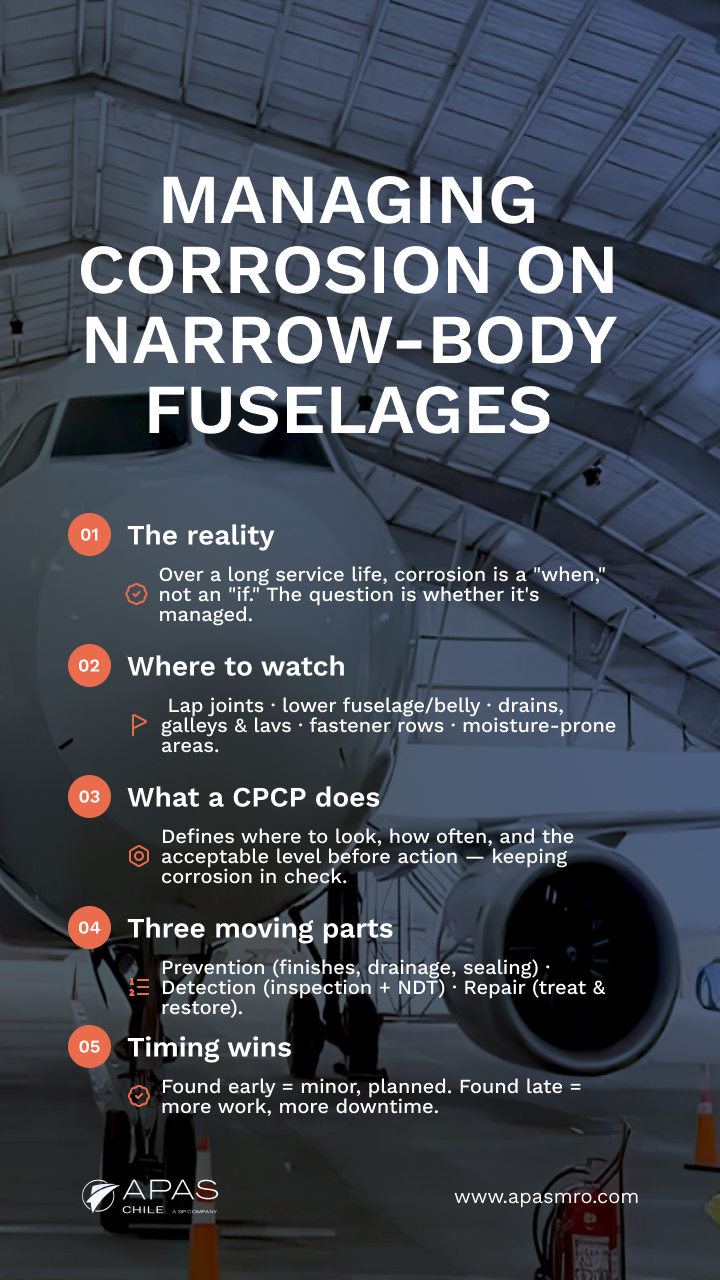
Fuselage structure lives in a demanding environment. Pressurization cycles, moisture, temperature swings, cleaning agents and accumulated service time all create conditions where corrosion starts, usually in places a walk-around will never show.
On narrow-body aircraft the recurring areas of attention are consistent: lap joints, the lower fuselage and belly zones, the structure around drains, galleys and lavatories, fastener rows, and any location where moisture collects and stays.
None of that is unusual. It is the normal condition of an aircraft that has been flying for years. The question is never whether corrosion exists. It is whether it is being found on a schedule or by accident.
The three corrosion levels, and what each one obliges
This is the part that decides your days, and it is defined rather than negotiable.
The FAA's corrosion program order sets out three levels. Level 1 is damage occurring between successive inspections that is local and can be reworked or blended out within the manufacturer's allowable limits. Level 2 is damage whose rework or blend-out exceeds those allowable limits, requiring a repair or the partial or complete replacement of a principal structural element. Level 3 is damage the operator determines to be a potential airworthiness concern requiring expeditious action.
The intent of a CPCP is to hold corrosion at Level 1. Finding Level 1 during scheduled corrosion tasks means the program is working. Anything above it means the program has to change.
Level
What it means on the aircraft
What it obliges beyond the repair
What it costs in days
Level 1
Local, blends out within the manufacturer's limits
Nothing beyond documentation and return to service
Absorbed inside the visit. The programme is confirmed, not adjusted
Level 2
The blend-out exceeds allowable limits; a principal structural element needs repair or replacement
Reported to the manufacturer for evaluation; the programme may need adjusting — shorter repeat interval, lower implementation age, added drainage
A different work package than the one you scoped, and a part you may not have
Level 3
Determined to be a potential airworthiness concern requiring expeditious action
The authority is notified immediately. Unless the finding is shown to be isolated, the affected areas must be inspected across the whole model fleet within 7 days
Beyond this aircraft. It becomes a fleet campaign, and the programme correction goes to the authority within 60 days
Read that table as a planner rather than as an engineer and the point lands. A Level 1 finding costs you a task. A Level 3 finding costs you the fleet.
The detail nobody plans for: the second blend
Here is a rule that changes decisions and is almost never written down for operators.
An area classified Level 1 and blended within limits does not stay Level 1 by default. If that same area is blended a second time, it becomes Level 2 — with everything Level 2obliges. And according to a technical review of corrosion programs carried out for the FAA, carriers track successive blending poorly or not at all, which means the information that would have predicted the reclassification is frequently missing at the moment it is needed.
The practical consequence is uncomfortable and worth acting on: a fleet that has been managing recurring light corrosion successfully for years may be one blend away from a different category of work, and not know which aircraft is closest to it.
That same review found a second trap for mixed fleets. The definition of Level 1 is not identical across manufacturers and authorities —Level 2 and Level 3 are largely standardized, but Level 1 is not. An operator running both A320-family and 737 aircraft is applying two slightly different thresholds for the same word, in the same hangar, on the same week.
Anticipating the finding or waiting for it
Now the question the program does not answer for you: is it better to treat corrosion as planned work inside a visit, or to wait until it is found?
There is no universally correct answer, and anyone who gives you one is selling something. There is a comparison, and it is rarely laid out honestly:
Corrosion treated as planned work
Corrosion found with the aircraft open
When you decide
Before the slot, with the scope negotiable
During the visit, with the release date already published
What the work package looks like
Known tasks, known access, known materials
An addition to a package that was already scoped and costed
Parts
Ordered against a forecast, with time to clear customs
Ordered against a finding, against the clock
Level escalation risk
Lower: repeat blends are visible and tracked
Higher: the second blend is discovered, not anticipated
What happens if it is worse than expected
The scope grows before the aircraft is committed
The scope grows after the network plan is committed
What it costs
More scoped hours, budgeted
Fewer scoped hours, and days that were not budgeted
The column on the left is not free. It buys hours you might not have needed. The column on the right is cheaper right up until the moment it is not, and what makes it expensive is never the corrosion — it is that the decision arrives when there is no room left to make it.
One thing the program is explicit about, and it removes an option operators sometimes assume they have: deferral of the corrosion tasks themselves is generally not allowed. A complete numbered corrosion task is meant to be performed on the structure at its predetermined interval. Sliding the inspection is not a way to buy time.
Detection is what keeps findings at Level 1
Since the whole system is built on holding corrosion at Level 1, detection is not a supporting activity. It is the mechanism.
Scheduled inspection finds what is visible. What is early-stage, hidden under structure, or under a fastener head usually is not visible, which is where non-destructive testing does the work that a trained eye cannot. Finding corrosion while it still blends out within limits is the difference between a documented task and a reportable event.
And the other half of the mechanism is location. When a finding does need more than a blend, the aircraft needs to be somewhere that can act on it — with the heavy maintenance capability and the inspection methods already on site, rather than being routed somewhere else at short notice with the clock running.
Where corrosion sits among the other findings
Corrosion is one of the findings that a scheduled visit exists to surface, and it behaves like the others: the program says what to open, and the aircraft says what is inside.
The difference between a heavy visit and line work matters here, because corrosion findings are almost entirely a heavy-visit phenomenon — they appear when structure is opened, and structure is opened on a schedule measured in years.
The engine has its own version of the same story: an internal finding that costs a shift or costs months depending on what can be closed on site. Corrosion and engine findings are different disciplines with the same underlying arithmetic.
Frequently asked questions
Which airframe programs cover corrosion findings during scheduled checks?
A Corrosion Prevention and Control Program covers the scheduled corrosion tasks, the definitions of the corrosion levels, the compliance times, and the procedures for modifying the program when a finding exceeds Level 1. What it does not cover is the repair of a finding that turns out to be Level 2 or 3 — that becomes separate work, and separate days.
Can a corrosion task be deferred to the next visit?
Generally no. Deferral of an inspection within the numbered corrosion tasks, or of parts of the basic task such as corrosion removal or inhibitor application, is not normally allowed. The program depends on the complete task being performed at its interval.
Does one Level 3 finding affect the rest of the fleet?
Yes, and quickly. Unless the operator can show the finding is an isolated occurrence, the affected areas must be inspected across the model fleet within seven days of the determination, or on a schedule presented to and accepted by the authority.
Do Airbus and Boeing define the corrosion levels the same way?
Level 2 and Level 3 are largely standardized across manufacturers and authorities. Level 1 is not — the definitions differ, which creates real ambiguity for operators running mixed narrow-body fleets under a single maintenance organization.
What this changes about planning your next check
Corrosion on a narrow-body fuselage over a long service life is not a question of if. It is a question of whether it is being tracked well enough that the findings stay in the category that costs you a task rather than the category that costs you a fleet campaign.
Two things do most of that work, and neither is exotic: detection good enough to find corrosion while it still blends out within limits, and a record of successive blends good enough that the second one is anticipated instead of discovered.
If you are scoping a heavy visit for a narrow-body fleet and want the corrosion tasks planned rather than discovered, request an assessment while the scope is still negotiable.
Need Critical Parts Support—Now?
Our AOG response team is standing by 24/7 to source, quote, and dispatch the components you need.