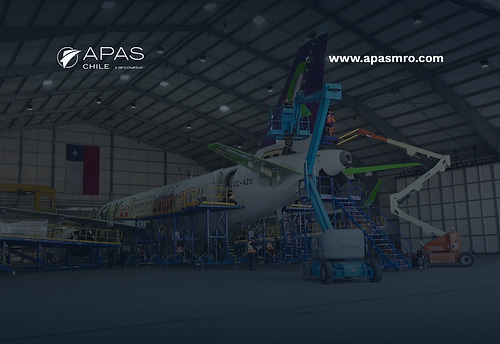
Heavy Maintenance Checks: Where the Days Are Really Lost
A heavy check is planned on its task cards and finished on what they uncover. How non-routine findings move, where they wait, and what to ask before the slot.
Heavy Maintenance: What Decides If the Check Ends on Time
Heavy maintenance is the scheduled visit in which an aircraft is opened far enough that the work package can no longer be fully known in advance. In regulatory language it isa C-check, a D-check or an equivalent airframe operation. In practice, it is the one maintenance event where the work nobody scoped decides how long the aircraft stays in the hangar.
That second definition is the one a fleet planner lives with. The visit is booked months ahead and costed against task cards everyone can read in advance. What nobody can read in advance is what those task cards will open up.
So this article looks at heavy maintenance from the planner's side: not which checks exist, but where a heavy check gains or loses days once the panels come off. The argument fits in one line. A heavy check finishes on time when the non-routine work it uncovers can be assessed, approved, supplied and closed without leaving the facility, and the way the provider is organized decides that more than any single finding does.
What heavy maintenance covers, and why a heavy check is different
A heavy maintenance visit (HMV) is a scheduled check deep enough to require hangar access, structural inspection and the removal of panels, components or surfaces that stay closed in normal operation. For narrow-body fleets it usually means the C-check; the D-check is the deepest version of the same idea. Many operators call this hangar work base maintenance.
The scope of a heavy check typically combines:
structural inspections, including the corrosion tasks of the CPCP;
fuel tank inspections and repairs;
landing gear work and flight control surface removal or replacement;
component removals and replacements, and engine-related checks;
service bulletins, airworthiness directives and cabin modifications where applicable;
NDT, engineering review and the records that support the return to service.
What separates heavy maintenance from lighter work is not the length of that list. It is that the heavy check is the visit designed to look where nobody has looked for years. The step-by-step workflow of a narrow-body C-check, from induction to return to service, is covered in how a C-check is scoped and timed. The question here is what happens to that workflow once the inspections start producing findings.
Routine and non-routine work in a heavy maintenance visit
Every heavy check carries two packages. The routine package is the set of task cards the maintenance program requires, scoped and costed before the aircraft arrives. The non-routine package is everything those task cards uncover, and it is written during the visit, card by card.
Corrosion beyond limits, a cracked bracket, a worn bushing: none was in the quote, and each becomes anon-routine card (NRC) with its own labor, material and approval.
The size of that second package depends on the aircraft more than on the check. A maintenance executive interviewed by AviTrader puts the extra cost from findings at 10–20% on well-maintained aircraft. On older or poorly maintained aircraft, he notes, non-routine work can match the routine labor itself.
That range is the most useful figure a planner can hold before a heavy maintenance visit, because it says where the schedule risk sits. Two aircraft on the same program, booked for the same check, can carry very different risk. The difference is written in their maintenance history.
This is also where heavy and line maintenance meet. Repetitive defects, corrosion observations and recurring system findings logged between flights are the best forecast available of what the heavy check will open. A fleet that feeds that history into the work package before the slot is planning its non-routine package instead of discovering it.
The non-routine loop: where heavy maintenance aircraft lose days
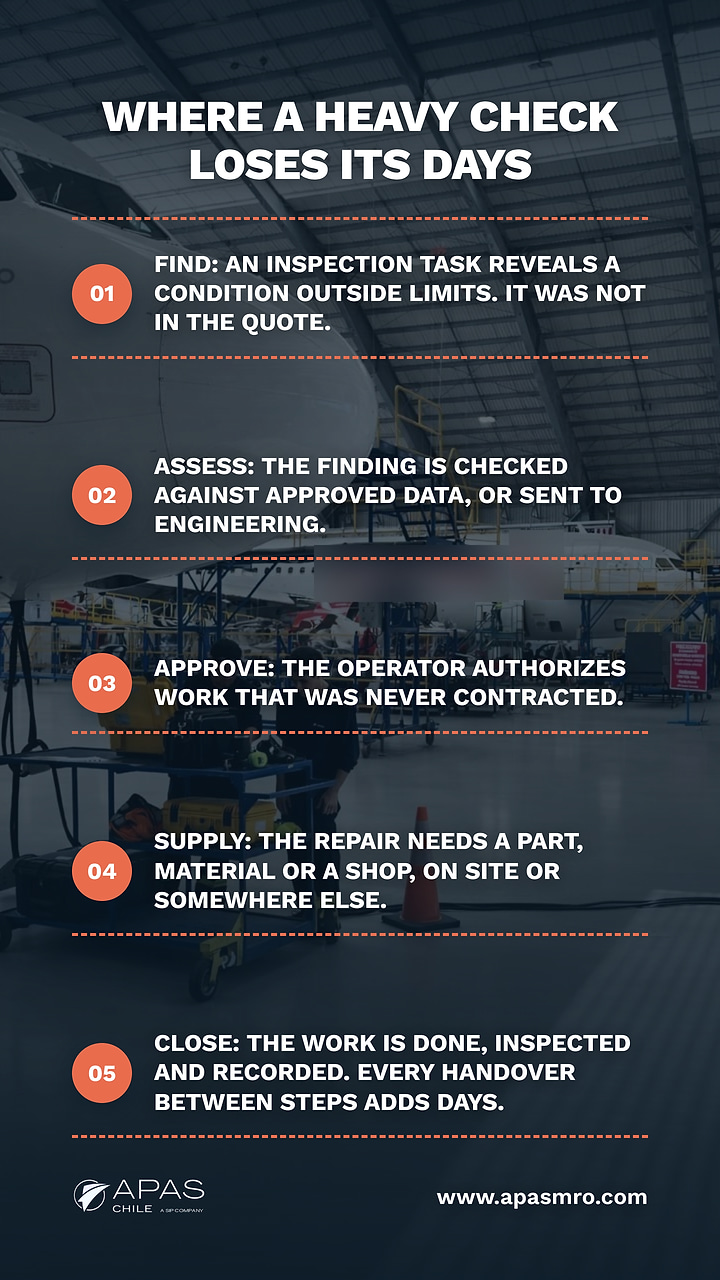
A finding does not cost days by existing. It costs days while it waits, and every non-routine card in a heavy check follows the same five steps, each of which can turn into a queue. The check run slate when cards sit between those steps, not when the work inside them is hard.
Find. An inspection task reveals a condition outside limits.
Assess. The condition is evaluated against approved data, such as the structural repair manual and the manufacturer's limits, or sent to engineering when that data does not cover it.
Approve. The operator authorizes the additional work, because it was not part of what was contracted.
Supply. The repair needs material, a part or a shop, either on site or somewhere else.
Close. The work is performed, inspected and documented in the records that support thereturn to service.
In a poorly organized visit, each step adds a handover. The assessment waits for an engineerelsewhere, the approval waits for a reply from another time zone, and the part waits in a crate. Theaircraft stays open the whole time.
Fragmented vs integrated heavy checks: where the days go
The same five-step loop behaves very differently depending on how many organizations it has tocross. In a fragmented heavy check, the hangar inspects while components go out to third-party shops,NDT is subcontracted, engineering sits elsewhere and parts arrive through a separate logistics chain.In an integrated heavy check, those disciplines share one site and one organization.
Removed parts leave the site for repair and come back
Removed parts go to an in-house shop
Engineering assessment
Requested from an outside party, in that party's queue
Raised and answered inside the same organization
Operator approvals
Coordinated across several providers, each with its own quote
One quote per finding, one counterpart
Parts and customs
Each shipment cleared on its own, against the clock
Stock and clearance handled where the aircraft is
Records
Assembled from several sources at the end of the visit
Built in one system as each card closes
Where the days are lost
In transfers, handovers and waiting for answers
In the work itself
Integration does not remove findings, and it does not guarantee a date. What it changes is the number of times a finding changes hands. Fewer handovers mean fewer queues, and fewer queues are where on-time heavy checks come from.
Fragmentation also has a cost that never appears in a quote. When line findings do not reach the heavy maintenance planners or engineering review starts late, nobody is individually at fault. The days are lost between organizations, and nobody owns the gap.
What to confirm before committing a heavy maintenance slot
The decisions that protect a heavy check's schedule are made before the aircraft arrives. Before the slot is signed, confirm where the likely non-routine work can be closed, how additional work will be approved, and where the parts will come from. After the first finding, those questions only have expensive answers.
Five questions do most of that work:
Which disciplines are on site? Structures, NDT, component shops and engine support. Every discipline that is not on site is a transfer waiting to happen.
How will additional work be approved? Thresholds agreed in advance, meaning what can proceed up to a given value without a new authorization, take the approval queue out of the common findings.
What does the maintenance history predict? Repeat defects and earlier corrosion findings belong in the scoping conversation, not in the surprise column.
Where are the parts held, and how do they clear? Material that has to cross a border during the visit carries its own lead time.
Which authorities will the work be released under? An approval only matters if it covers your registry, so what each certification actually authorizes is worth checking before the slot rather than at release.
Timing matters too. Oliver Wyman's latest fleet and MRO forecast describes a "bow wave" of deferred maintenance that is creating capacity bottlenecks and longer turnaround times. When capacity is tight across the MRO market, the organization behind a slot matters as much as its date.
Heavy maintenance vs line maintenance, briefly
Heavy maintenance and line maintenance run on different clocks. Heavy maintenance is planned months ahead and measured in days of scheduled downtime; line maintenance is decided between flights and measured in hours against the next departure. Line work keeps the aircraft dispatchable, while the heavy visit restores what years of operation have worn.
The two connect through findings: what line maintenance defers or keeps repeating is what the heavy check eventually opens. The decisions taken on the ramp, under the MEL and against the clock, have a logic of their own, set out in how line maintenance decides dispatch readiness. For where both services sit inside a maintenance organization, see what an MRO does.
Heavy maintenance at SCL
For A320-family and Boeing 737 operators in Latin America, heavy maintenance in Santiago with APAS Chile keeps the non-routine loop under one roof at Santiago International Airport. Structures, NDT, the engine shop and the component shops work on the same site as the aircraft. A bonded warehouse inside the primary customs zone keeps parts clearance next to the hangar.
The work is performed under FAA and DGAC CMA-655 approvals, together with other Latin American civil aviation authorities. As part of SIP Aviation Group, APAS Chile also draws on the group's inventory.
Measured against the five steps above, that means assessment, supply and closure happen where the aircraft is, and the operator deals with a single counterpart for every finding.
Frequently asked questions
What does heavy maintenance mean in aviation?
Heavy maintenance is a scheduled, in-depth check, typically a C-check, a D-check or an equivalent airframe operation, in which the aircraft is taken out of service, opened up and inspected structurally. It requires a hangar, specialized tooling and a work package that grows as findings appear.
What is an HMV?
HMV stands for heavy maintenance visit: the time an aircraft spends in the hangar for a heavy check. The term covers the whole visit, including the routine task cards, the non-routine work they uncover and the records needed to return the aircraft to service.
Is base maintenance the same as heavy maintenance?
Largely, yes. Base maintenance is the term commonly used for maintenance carried out in a hangar, as opposed to line maintenance on the ramp. Heavy checks are the core of base maintenance, although abase visit can also be shorter or narrower in scope than a full heavy check.
Why do heavy maintenance checks overrun?
Mostly because of non-routine work: findings that were not in the scoped package and must be assessed, approved, supplied and closed while the aircraft stays open. The more organizations each finding has to pass through, the more waiting the visit accumulates.
Before the next heavy check is booked
The date of a heavy check is not decided on the day the hangar doors open. It depends on how shorthe non-routine loop is, and the length of that loop is fixed when the provider is chosen: by which disciplines sit next to the aircraft, by how approvals are agreed, and by where the material is held.
So the useful conversation happens before the slot: bring the aircraft's maintenance history, ask where each likely finding would be closed, and plan the visit against the answer. Request a maintenance assessment for your next heavy check in Santiago.
Need Critical Parts Support—Now?
Our AOG response team is standing by 24/7 to source, quote, and dispatch the components you need.