On-Wing Engine Borescope Inspections: When Are They Required?
A borescope inspection of an aircraft engine rarely costs days. Reading what it finds does. Here is how each finding moves your aircraft release date.
What an Engine Borescope Inspection Finding Costs You
An engine borescope inspection is the moment a maintenanceplan stops being a forecast. A probe goes in through an approved port, theinternal condition of the engine becomes visible, and everything downstream ofthat image — the work package, the parts order, the release date — is rewrittenagainst what is on the screen. The inspection itself rarely costs days. Readingwhat it finds is what costs days.
That gap is where most planning goes wrong. Operators treat the borescope as an inspection event and schedule it as one, then discover that the finding, not the inspection, is what decides whether the aircraft leaves on the date already published in the network plan.
So the useful question is not whether a borescope inspection can be done on-wing. It is: what does each type of finding oblige you to do next, and what does that next step cost in aircraft days?
What an aircraft borescope inspection actually decides
An on-wing borescope inspection gives you visual evidence of internal engine condition without removing the engine from the aircraft. Through approved access ports, the compressor, combustion and turbine areas can be examined according to the applicable engine manual. What the inspection produces is not a verdict. It is the evidence on which four different verdicts become possible.
Those four are the only outcomes that matter to a schedule: continue, monitor, correct on-wing, or remove the engine. Everything else in the procedure exists to tell you which of the four applies.
This matters because the four are not evenly spaced. The distance between "monitor" and "correct on-wing" is usually hours. The distance between "correct on-wing" and "remove the engine" is measured in months, and that is the frontier the rest of this article is about.
What triggers a borescope inspection: intervals and events
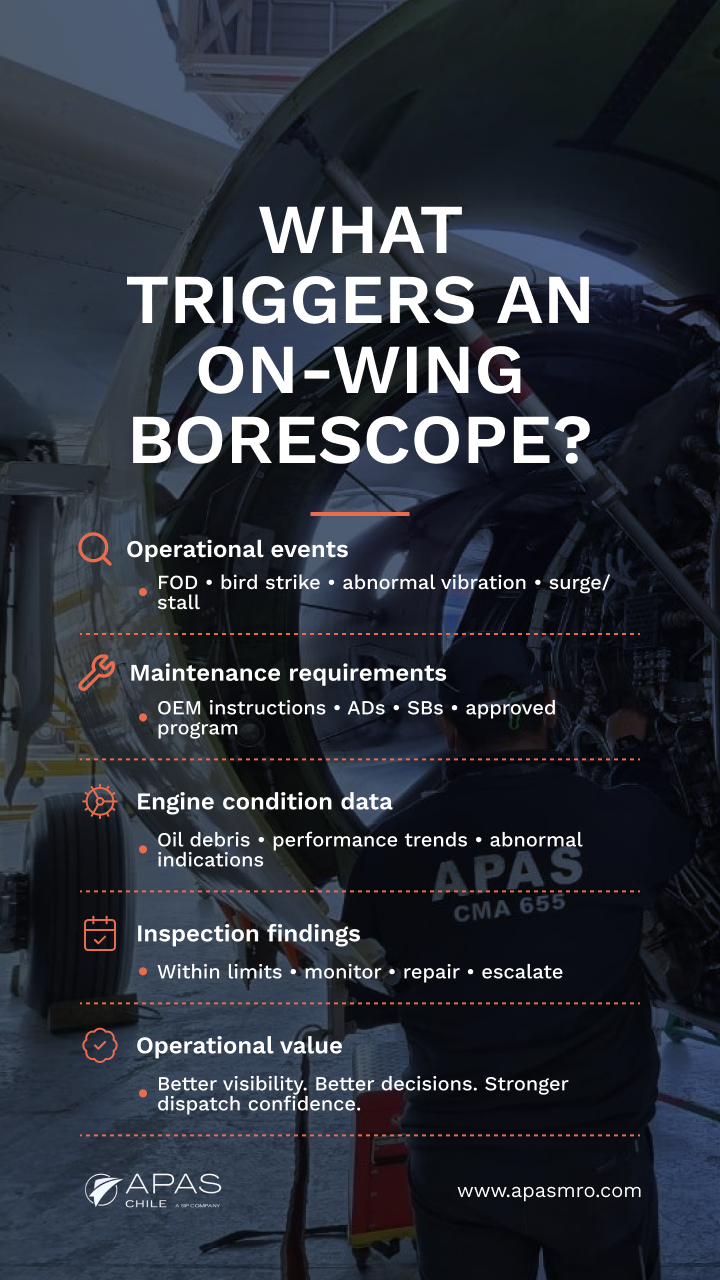
Borescope inspections come from two directions. Some a rescheduled — by flight hours, flight cycles, calendar time, engine condition monitoring data, or an interval written into the approved maintenance program. Others are triggered by something that happened.
The event-driven triggers are the ones that arrive without warning, and the common ones are consistent across narrow-body fleets:
Suspected foreign object ingestion, after debris, a bird strike or runway contamination, where external signs may be limited but internal damage is possible. Abnormal engine indications — vibration, exhaust gas temperature trend shifts, a surge or stall event, uncommanded thrust change, or performance deterioration. Oil analysis or chip detector findings suggesting internal wear. Severe environmental exposure, including volcanic ash.
Not every abnormal indication requires an inspection. The requirement depends on the event, the thresholds in the applicable instructions, and engineering assessment. What is worth noticing is the planning consequence: a scheduled inspection can be slotted, and an event-driven one cannot. The second kind lands on a schedule that is already committed.
Requirements themselves come from the approved maintenance program, OEM manuals, service bulletins, Airworthiness Directives, reliability findings or maintenance control decisions. Airworthiness Directives are mandatory within their compliance time. Service bulletins are recommended unless an AD, a regulation or the operator's program makes them otherwise.
Reading the finding: what the image on the screen means
Here is the part that almost never gets written down. The words used to describe borescope findings are not loose descriptions — they are defined damage categories, and each one implies a different next step and a different cost in time.
The FAA's powerplant handbook defines them precisely. Erosion is loss of metal by the mechanical action of foreign objects such as grit or sand, leaving a rough surface lined in the direction the material travelled. Burning is surface damage from excessive heat. A nick is a local displacement of material. And the rule that decides the money: nicks on a blade leading edge must be completely blended out, and if too much material has to be removed, the blade is rejected rather than repaired.
One finding carries more weight than the others. When stress rupture cracks or deformation appear on the leading edges of first-stage turbine blades, an over-temperature condition must be suspected — which turns a blade question into an engine question, because the cause is upstream of what you are looking at.
What the borescope shows
What it usually means
The decision it opens
What it costs in aircraft days
Minor blade nicks or dents within limits
Ingestion of small debris; local displacement of material
Blend within allowable limits, document, return to service
None, if it is caught inside a visit that is already open
Blade erosion
Sustained operation in an abrasive environment; a fleet pattern, not an event
Assess against limits; feed the trend into engine condition monitoring
None now. It sets the interval for next time
Carbon build-up or coating loss in the combustion area
Thermal history of the engine; often progressive
Trend and monitor, or rectify at the next scheduled opportunity
Usually none, provided it is planned rather than discovered late
Damage that exceeds the blend limit
Too much material would have to be removed to restore the part
Blade rejection: a part is now required
Absorbed inside the visit if the part is on site. Otherwise the check waits on the part
Stress rupture cracks or leading-edge deformation, first-stage turbine
An over-temperature condition must be suspected; the cause is upstream
Engineering assessment, and probably engine removal
Shop-visit territory — see the next section
Anything the access port cannot fully assess
The finding is real but the boundary of the damage is not visible on-wing
Escalate to a deeper inspection method or to the shop
Depends entirely on which of the two it turns out to be
Read the last column and the pattern is obvious. Most findings cost nothing extra as long as the capability to close them is already where the aircraft is. The cost appears at the moment a finding requires something the site does not have: apart, a method, a shop.
What stays on-wing, and what a shop visit now means
On-wing correction is appropriate when the area can bereached through approved ports and the applicable instructions allow assessmentand rectification without removal. Engine removal enters when damage exceedsallowable limits, when the affected area cannot be fully assessed in place,when deeper disassembly is needed, when shop-level tooling or test capabilityis required, or when the approved procedure simply says so.
That decision is not about speed. It is about access,limits, documentation and safety. But it is worth knowing what it now costswhen it goes the second way.
Narrow-body engine shop turnaround times are regularly 180 to 200 days or more for many operators, well above pre-pandemic levels. That is the real width of the frontier. A borescope finding that stays on-wing costs a shift. The same finding one category worse can put the engine into a queue measured in half a year.
Which is why the sentence "we can inspect on-wing" is worth much less than it sounds, and the sentence "we can close the finding without removing the engine" is worth a great deal. The second one requires an engine shop, qualified people and the part, in the same place as the aircraft. A maintenance visit only holds its date when the finding can be closed where the aircraft already is.
What "we can inspect on-wing" has to mean to be worth anything
Inspection readiness is not equipment. A borescope kit in a cabinet is the cheapest part of the capability and the least useful on its own.
What determines whether an inspection turns into a decision on the same day is a shorter list than most capability statements suggest, and every item on it is a person or a procedure rather than a tool: qualified personnel current on the engine type, approved inspection procedures for the specific requirement, correct access and tooling, maintenance control able to take the call, documentation standards that hold up when the finding is disputed, and engineering support available when the image is ambiguous.
The last one is the one that quietly costs days. Findings are often not clear-cut. An image that needs an engineering opinion, on a site where that opinion is somewhere else and several hours behind, does not produce a decision — it produces a wait. Then the aircraft is holding a slot while a question travels.
Where all of that is in place, a routine trigger stays routine. Where it is not, the trigger itself becomes the delay, before anyone has even argued about what the finding means.
When the finding is not the problem — the part is
There is a second cost that borescope planning consistentlyunderestimates, and it is not technical.
A finding that requires a replacement part does not cost you the repair. It costs you the wait. In the industry's own supply-chain survey, 80% of respondents named piece-part availability as the leading reason maintenance turnaround times have increased — ahead of labor, ahead of capacity, ahead of OEM control of repairs.
For an operator that means the borescope finding is only half the question. The other half is whether the part that the finding requires is already in the country, already released by customs, and already on a shelf near the hangar. That part of the answer is decided long before the probe goes in.
Where the borescope sits inside the visit
Inside a heavier check, a borescope inspection is one of several planned windows into a condition nobody can see from outside. It behaves the same way as every other inspection in a scheduled maintenance visit it converts an unknown into a decision, and the decision has a clock on it.
The borescope is a visual method. When a finding needs to be bounded rather than seen — how far a crack runs, what lies under a surface — it hands over to other inspection methods, which isa different discipline with different equipment and different qualifications.
For an operator planning a visit in Santiago, the practical consequence is narrow and specific: an engine shop on the same site as the aircraft changes which findings can be closed without the engine leaving. It does not make findings less likely. It changes what they cost when they appear.
Frequently asked questions
Can a borescope inspection be deferred?
It depends on where the requirement comes from. If it is driven by an Airworthiness Directive, a mandatory task, an event-based procedure or an approved program interval, any extension or deviation must follow the operator's approved procedures and the applicable regulatory requirements.
How long does an on-wing borescope inspection take?
It depends on engine type, access, how many areas are inspected, documentation requirements and what is found. A limited inspection is considerably faster than a broad post-event assessment that needs engineering review. The variable that moves the schedule is the finding, not the inspection.
What findings require action before further operation?
Findings that exceed allowable limits, or that cannot be assessed within the approved instructions, require corrective action before the aircraft flies again. The classification is made against the applicable engine manual, not by judgement at the port.
Is a borescope inspection the same as NDT?
No. A borescope inspection is a visual internal inspection method. Depending on the finding, additional non-destructive testing or shop-level inspection may be required to bound the damage.
What to do with this before the next inspection
A borescope inspection does not create risk to a schedule. It reveals the risk that was already there — and it reveals it at the least convenient moment, once the aircraft is in the hangar and the release date is published.
The operators who lose the fewest days to engine findings are not the ones with fewer findings. They are the ones who arranged, before the visit, for the likely findings to be closeable on site: a shop, a method and a part in the same place as the aircraft.
If you are planning a narrow-body visit and want to know which engine findings could be closed without the engine leaving the hangar, ask for an assessment before the slot is committed rather than after the probe goes in.
Need Critical Parts Support—Now?
Our AOG response team is standing by 24/7 to source, quote, and dispatch the components you need.