Aircraft Maintenance in Chile: What Operators Should Evaluate Before Choosing an MRO
Learn what operators should evaluate when choosing aircraft maintenance in Chile, including approvals, line and heavy maintenance, engine support, NDT, logistics, and documentation.
Aircraft Maintenance in Chile: What Operators Should Evaluate Before Choosing an MRO
Introduction
For airlines and operators flying into Chile or managing fleets across Latin America, aircraft maintenance planning depends on more than geographic convenience.
The right MRO provider should offer the approved scope, technical capability, documentation process, operational coordination, and support services required for the aircraft, work package, and registry involved.
Chile can be operationally relevant for operators with routes through South America, especially when maintenance support is available at Santiago International Airport. But choosing an MRO in Chile should not be based only on location.
Operators should evaluate the provider’s line maintenance, heavy maintenance, engine support, component shops, NDT capability, logistics coordination, documentation standards, and ability to support scheduled and unscheduled maintenance needs.
This article explains what operators should consider when evaluating aircraft maintenance support in Chile.
Why Chile Matters for Aircraft Maintenance in Latin America
Chile’s location may be relevant for airlines operating within South America or connecting through the region. Santiago International Airport can serve as an important operational point for carriers that need line maintenance, scheduled maintenance coordination, technical support, or additional MRO services in the region.
For operators, the value of a maintenance location depends on several factors:
proximity to active routes;
airport infrastructure;
availability of technical personnel;
approved MRO capabilities;
access to hangar or ramp support;
parts and tooling coordination;
customs and bonded storage processes;
documentation and release requirements;
communication with maintenance control.
A local MRO presence can help operators coordinate maintenance activity closer to the operation. However, the actual benefit depends on the work scope, aircraft type, approval requirements, findings, parts availability, documentation, and operational urgency.
For this reason, operators should evaluate Chile as part of a broader maintenance planning strategy, not only as a location.
What Approvals Should Operators Verify?
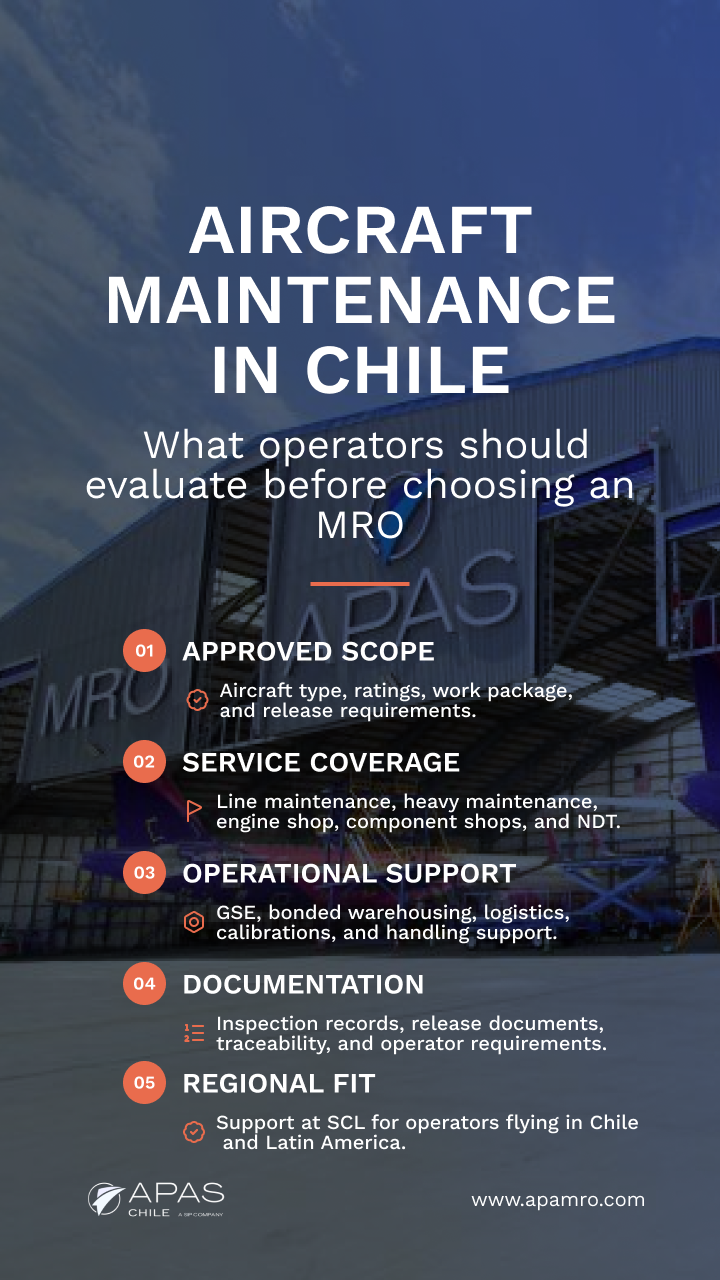
Before selecting an MRO in Chile, operators should confirm which approvals apply to the aircraft registry, work scope, operator requirements, and release process.
Depending on the aircraft and the type of maintenance required, relevant approvals may include:
Chilean aviation authority approval;
FAA Part 145 approval, where applicable;
EASA Part 145 third-country approval, where applicable;
ratings and limitations for the aircraft or component;
personnel authorizations;
approved maintenance data;
quality procedures;
release documentation requirements.
The important point is not only whether a certificate exists.
Operators should verify that the provider’s approval scope, tooling, qualified personnel, technical data, facilities, and documentation process match the specific work being requested.
For example, a provider may support line maintenance for one fleet type, heavy maintenance for another, and component or shop services only within defined capability limits.
The operator should confirm this before scheduling work, especially for international fleets, leased aircraft, or aircraft subject to specific registry and lessor requirements.
What Maintenance Capabilities Should Operators Evaluate?
A full MRO evaluation should look beyond one service line.
Operators should assess whether the provider can support the maintenance event as a complete operational process.
Key capabilities may include:
line maintenance;
heavy maintenance;
engine shop or powerplant support;
component and accessory shops;
NDT services;
structural repair capability;
GSE and handling support;
calibrations;
bonded warehousing;
documentation and records control;
technical training support.
For line maintenance, operators should evaluate support for transit checks, daily or weekly checks depending on the maintenance program, troubleshooting, defect rectification, LRU replacement, and MEL-related coordination where applicable.
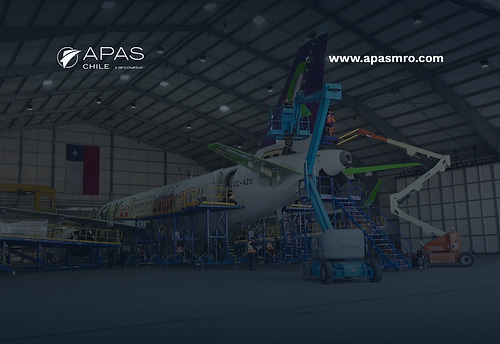
For heavy maintenance, operators should evaluate hangar capacity, work package planning, structural inspections, fuel tank work, corrosion findings, landing gear-related tasks, flight control surface work, cabin modifications, service bulletin implementation where applicable, and documentation control.
For engine support, operators should assess whether the provider can support tasks such as borescope inspections, engine preservation, QEC-related work, gearbox replacement, or other powerplant tasks within approved scope.
The goal is to understand whether the MRO can support the operator’s actual maintenance needs, not only provide a general list of services.
Why Integrated MRO Support Matters
Operators often face coordination challenges when line maintenance, heavy maintenance, component repair, engine support, NDT, logistics, and documentation are handled through multiple disconnected providers.
Fragmented coordination may create problems such as:
unclear responsibility between providers;
delays in parts or tooling movement;
repeated information requests;
incomplete documentation;
late escalation of findings;
limited visibility into repair or inspection status;
additional coordination between the operator, shops, logistics teams, and maintenance control.
An integrated MRO structure can help improve visibility when related services are coordinated under a clearer operational framework.
This does not eliminate findings, delays, or documentation requirements. But it can help operators understand what is happening, who is responsible, and what decision is needed next.
For APAS Chile, this is especially relevant because the company’s service footprint combines line maintenance, heavy maintenance, engine shop support, accessory and component shops, NDT, GSE, warehousing, calibrations, and technical training capabilities at SCL.
How Do Logistics and Customs Support Affect Maintenance Planning?
Maintenance planning in Latin America may require additional attention to logistics, customs coordination, parts movement, tooling, and documentation.
Operators should evaluate whether the MRO can support:
inbound and outbound logistics coordination;
bonded storage for tools, parts, and components;
customs documentation support;
parts and component movement;
warehousing processes;
GSE availability;
handling support;
coordination with suppliers or external repair providers.
Bonded warehousing may support more efficient storage and movement of tools, parts, and components, subject to inventory availability, customs procedures, documentation requirements, and applicable regulations.
Operators should avoid assuming that logistics support automatically reduces turnaround time. The value is in having a clearer process for coordinating parts, documentation, and movement when maintenance needs arise.
This is particularly important during scheduled maintenance events, unscheduled findings, AOG situations, or when components need to move across borders.
What Should Fleet Managers Evaluate Before Selecting an MRO in Chile?
Fleet managers should evaluate an MRO provider through a practical qualification framework.
Important questions include:
Does the provider’s approved scope match the aircraft type and maintenance event?
Are the required ratings, tooling, facilities, and personnel available?
Can the provider support both scheduled and unscheduled maintenance needs?
What line maintenance services are available at the station?
What heavy maintenance services are available in hangar?
What engine support can be performed under approved scope?
Which component and accessory shops are available in-house?
What NDT methods and inspections can be supported?
How are findings communicated to the operator?
How are customer approvals handled when scope changes?
What documentation is delivered after maintenance?
Can the provider support logistics, bonded storage, GSE, and warehousing?
Who is the operational contact during the maintenance event?
The strongest MRO choice is not always the provider with the longest service list. It is the provider whose approved capabilities, documentation process, communication, and support structure match the operator’s actual needs.
Why A320 and B737 Support Matters for Operators in the Region
For operators flying Airbus A320 family and Boeing 737 fleets, APAS Chile’s service scope is especially relevant when the approved capabilities, tooling, personnel, facilities, and documentation processes match the required work.
Narrow-body operators often need coordinated support across:
line maintenance;
heavy checks;
engine-related tasks;
LRU replacement;
component shops;
NDT inspections;
structural work;
documentation and release records;
GSE and operational support.
Operators should confirm which aircraft types and specific tasks fall within the MRO’s approved scope before planning a maintenance event.
This is particularly important for carriers operating across multiple countries, lessors managing aircraft transitions, and operators that need maintenance support in Latin America without relying on disconnected service providers.
How APAS Chile Supports Operators at SCL
APAS Chile supports operators at Santiago International Airport with integrated MRO services for Airbus A320 and Boeing 737 fleets.
Its capabilities include:
line maintenance;
heavy maintenance;
engine shop and powerplant support;
accessory and component shops;
NDT services;
calibrations;
GSE and handling support;
bonded warehousing for tools, parts, and components;
Part 147 training center.
This structure helps operators coordinate scheduled and unscheduled maintenance needs through a local support base in Chile.
For airlines, lessors, and operators flying in Latin America, APAS Chile provides a practical point of coordination for line, heavy, engine, component, NDT, and complementary MRO support services at SCL.
Frequently Asked Questions
What should operators verify before choosing an MRO in Chile?
Operators should verify approved scope, aircraft type coverage, ratings, tooling, personnel qualifications, documentation process, release requirements, logistics support, and whether the provider can support the specific work package requested.
Can an MRO in Chile support foreign-registered aircraft?
It depends on the aircraft registry, operator requirements, applicable approvals, work scope, and release documentation. Operators should confirm whether Chilean, FAA, EASA, or other approvals apply to the specific aircraft and maintenance event.
How long does a C-check take in Chile?
C-check duration depends on aircraft type, approved maintenance program, work package, findings, parts availability, customer approvals, documentation, and hangar capacity. No universal timeline should be assumed without reviewing the specific aircraft and scope.
Why does bonded warehousing matter for aircraft maintenance?
Bonded warehousing can support storage and movement of tools, parts, and components under applicable customs procedures. Its value depends on inventory availability, documentation, customs requirements, and the maintenance event.
Which aircraft types are relevant for APAS Chile?
APAS Chile focuses on integrated MRO support for Airbus A320 and Boeing 737 fleets, depending on approved scope, work package, tooling, personnel, and documentation requirements.
Conclusion
Aircraft maintenance in Chile can be strategically relevant for operators flying across Latin America or managing maintenance needs through Santiago International Airport.
The key is to evaluate the MRO provider carefully.
Operators should review approved scope, aircraft coverage, line maintenance, heavy maintenance, engine support, component shops, NDT capability, logistics, bonded storage, documentation, and communication processes before choosing a provider.
Need aircraft maintenance support in Chile or Latin America? Contact APAS Chile to discuss your aircraft type, work scope, documentation requirements, and operational needs at SCL.
Need Critical Parts Support—Now?
Our AOG response team is standing by 24/7 to source, quote, and dispatch the components you need.