Line Maintenance & Operational Support
Avionics Repair MRO: Keeping the Flight Deck Dispatch-Ready
An avionics repair MRO keeps the flight deck dispatch- ready through avionics troubleshooting, bench testing, and instrument overhaul in Santiago.


Line Maintenance & Operational Support
An avionics repair MRO keeps the flight deck dispatch- ready through avionics troubleshooting, bench testing, and instrument overhaul in Santiago.
An avionics repair MRO keeps the flight deck dispatch-ready by diagnosing, repairing and bench-testing instruments and avionics units — proving the fix before the aircraft needs it.
The flight deck is unforgiving of faults. A blank display, a flagged instrument or an intermittent avionics fault can hold an aircraft on the ground even when everything mechanical is sound.
APAS Chile provides that capability through its avionics shop in Santiago.
Modern aircraft depend on avionics for navigation, communication, display and control — and the minimum equipment list is strict about what must work before a flight can depart.
That makes avionics and instrument health a direct driver of dispatch. A single failed instrument or communication unit can be enough to stop an aircraft.
Intermittent faults are especially disruptive, because they are hard to pin down on the ramp.
Avionics also age differently from mechanical parts. Failures can stem from connectors, solder joints, power supplies, or components that drift out of tolerance — and symptoms are often intermittent before they become permanent.
That is exactly why shop-level avionics repair matters. The shop can reproduce a fault, isolate its source and prove the fix on a bench, in ways that are impossible during a quick turnaround at the gate.
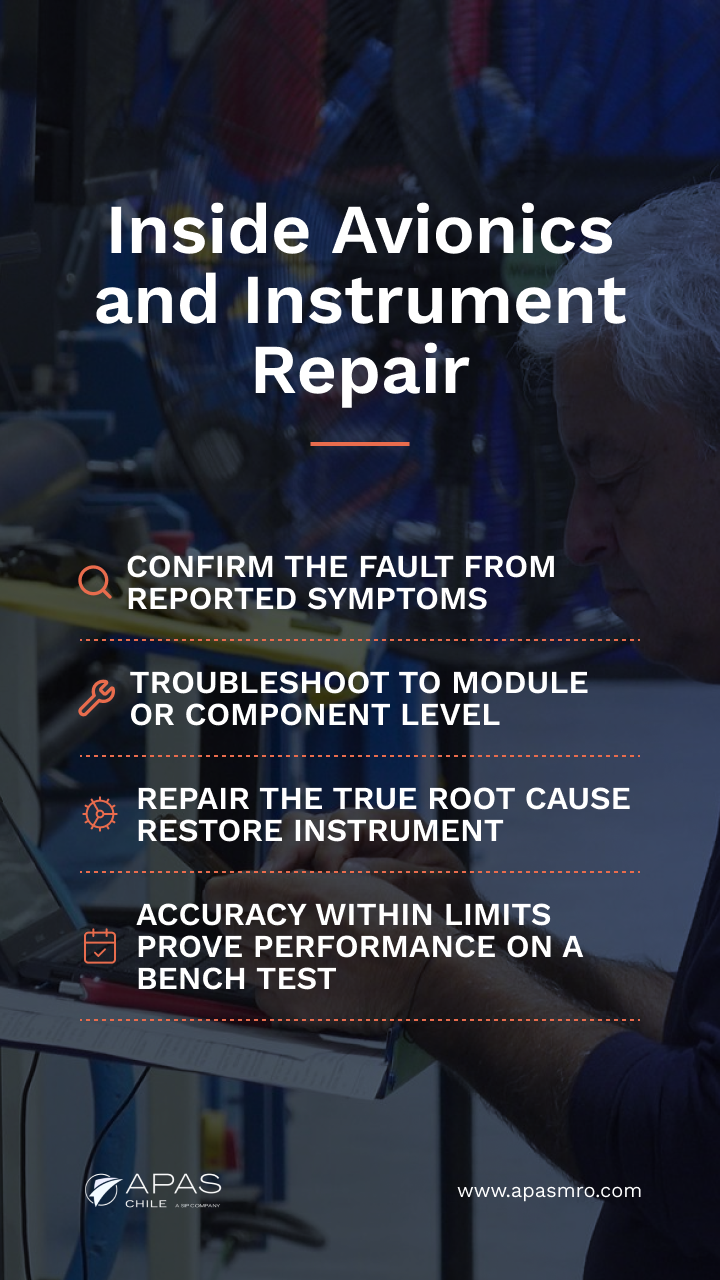
Aircraft instrument repair and avionics repair follow a structured path from fault to proven fix.
The unit is received with its reported symptoms, powered up, and evaluated to confirm and characterize the fault. Engineers then troubleshoot to component or module level, carry out the repair, and return the unit to the bench for functional testing against the manufacturer's specification before release.
Instrument overhaul carries the same discipline into indicators and sensors, restoring accuracy and confirming that readings fall within published limits across the operating range.
Whether the item is a display, a communication or navigation unit, or an instrument, the outcome operators need is the same: a repaired unit whose performance has been demonstrated, not assumed.
The hardest avionics problems are the ones that come and go.
An intermittent fault that will not repeat on the ramp costs operators time, and can lead to unnecessary swaps that never fix the real issue.
Effective avionics troubleshooting in the shop uses controlled conditions to reproduce the fault, then narrows it down systematically to the connector, board or component actually responsible.
Getting to root cause matters because it prevents the frustrating cycle of no-fault-found removals and repeat write-ups.
When the shop identifies and corrects the true source, the operator gets a unit that stays fixed — a direct contribution to dispatch reliability, and to reducing the hidden cost of chasing phantom faults.
An avionics bench test is where a repair is proven.
The bench applies the correct signals, power and stimuli to exercise the unit across its functions, and confirms it meets specification before it goes back on the aircraft.
That closes the gap between a repair that looks complete and one that is verified, giving the operator documented evidence that the unit performs as required.
Bench testing is also the best defence against repeat removals. A unit that seems fine on inspection can still fail under real operating conditions, and only functional testing reveals it.
Reliable calibration of test equipment underpins that confidence, and APAS Chile is building its calibration capability to support accurate, traceable measurement across its shops.
APAS Chile's avionics shop sits within an integral MRO in Santiago, alongside instrument, battery and other component capabilities — so avionics work can be coordinated with the rest of an aircraft's maintenance rather than shipped elsewhere.
Work is performed to the applicable component maintenance manuals under recognized certification, including DGAC Chile CMA-655 and FAA CRS APAY048E, giving operators traceable results.
Support from SIP Holding, with component inventory and a bonded warehouse, helps keep the parts and rotables needed for avionics and instrument repair available.
That matters in AOG situations, where a grounded flight deck needs a fast, reliable path back to service.
As an integral MRO, APAS Chile can also feed avionics findings into its reliability and engineering work, connecting shop results to fleet performance.
Operators reduce avionics-driven delays by combining good fault reporting with a shop that can reproduce, repair and prove faults — rather than simply swap units.
Clear symptom descriptions, unit histories and configuration details help the shop reach root cause faster and return a unit that stays serviceable.
If you need avionics or instrument repair that protects dispatch, contact APAS Chile and send your component and part-number details. The team can review the units and symptoms, and outline how the avionics shop can keep your flight deck ready.
An avionics repair MRO diagnoses, repairs and bench-tests avionics units and instruments. It confirms reported faults, troubleshoots to component level, performs the repair, and validates performance against specification before the unit returns to the aircraft.
Aircraft instrument repair at a shop reproduces the fault, isolates its true source, restores accuracy within published limits, and proves the result on a bench. A ramp swap only exchanges a unit, and can leave an intermittent or misdiagnosed fault unresolved.
Avionics troubleshooting uses controlled shop conditions to reproduce an intermittent fault, then narrows it to the responsible connector, board or component. Reaching root cause prevents the no-fault-found removals and repeat write-ups that a ramp check often misses.
An avionics bench test exercises a repaired unit across its functions to confirm it meets specification before installation. That verification reduces repeat removals and directly supports dispatch reliability by ensuring the unit stays serviceable.
Yes. APAS Chile operates an avionics shop as part of its integral MRO in Santiago, supporting avionics and instrument overhaul alongside battery and other component shops, with engineering and quality oversight and SIP Holding inventory for parts availability.
Our AOG response team is standing by 24/7 to source, quote, and dispatch the components you need.
Request a Quote Now