Aircraft Wheels and Brakes Overhaul: How Brake Shop Capability Protects Dispatch
How an aircraft wheels and brakes overhaul and a capable brake shop protect dispatch reliability, with wheel inspection and wear- limit planning.
A capable wheels and brakes shop is one of the most direct ways an MRO protects dispatch reliability. It keeps worn brakes and cracked wheel halves from becoming gate delays, by finding them on a bench instead of on the ramp.
Few components work as hard, or as quietly. Wheels and brakes absorb the energy of every landing, carry the full weight of the aircraft on the ground, and rarely draw attention until something threatens a departure.
It is a core part of what APAS Chile offers operators in Santiago.
Why Wheels and Brakes Deserve Dedicated Shop Attention
Wheels and brakes live in one of the harshest environments on the aircraft: high thermal loads during braking, mechanical shock on touchdown, contamination from runway debris and fluids, and constant fatigue cycling.
Over time, those conditions wear friction material, stress wheel halves, degrade bearings, and age the seals and tie bolts that hold everything together.
Because the assemblies are life-limited and condition-driven, they need structured inspection and overhaul — not run-to-failure attention.
An aircraft wheels and brakes overhaul is not a single task. It is a controlled disassembly, inspection, repair and reassembly process performed against the manufacturer's component maintenance manual.
Handled well, it returns a unit to service with predictable remaining life. Skipped, it becomes an on-aircraft failure that grounds the airplane at exactly the wrong moment.
What Happens During a Wheels and Brakes Overhaul
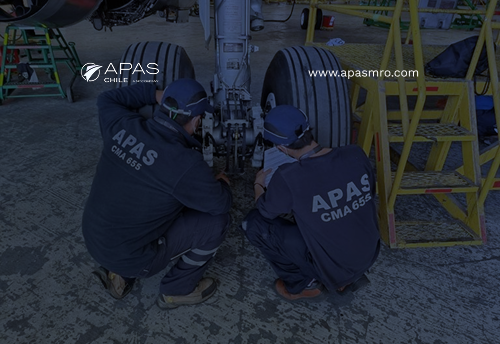
A wheel overhaul begins with tire removal, full disassembly of the wheel halves, and cleaning to strip away grease, oxidation and brake dust.
The shop then inspects the bearings, bearing cups, tie bolts and sealing surfaces, and subjects the wheel halves to non-destructive testing to reveal cracks that are invisible to the eye.
APAS Chile's NDT capability — including fluorescent penetrant and eddy current methods — supports exactly this kind of crack detection on wheel structures.
Brake overhaul follows a parallel logic. The assembly is disassembled, the heat stack or friction material is assessed against wear criteria, and the pistons, seals, adjusters and housing are inspected for heat damage, corrosion and leakage.
Worn or life-expired parts are replaced, seals are renewed, and the unit is rebuilt to specification.
Every step is documented, so the operator receives a clear record of what was inspected, what was replaced, and what remaining life was returned.
Understanding Brake Wear Limits and Wheel Inspection
Wheel
Brake
What is inspected
Bead seat, bolt holes, tie-bolts, bearing cups and the hub for cracks and corrosion
Heat stack condition, wear pin indication, pistons, seals and the torque tube
What drives removal
A crack, corrosion beyond limits, or an over-limit condition found at inspection
Wear reaching the limit, heat damage, or leakage
The method that finds it
NDT — cracks start where nothing is visible from the ramp
Measurement against wear limits, plus inspection of the stack once disassembled
What a ramp check can see
Tyre condition and obvious damage
The wear pin — and only what it indicates at that moment
What it cannot see
Fatigue cracking in the bead seat and bolt holes
The condition of the stack, the pistons and the seals
Effect on dispatch
A wheel change is quick; finding the crack too late is not
A brake at its limit on the day of departure is an avoidable delay
Brake wear limits exist because friction material and heat stacks are consumable by design.
Each manufacturer defines how much wear is acceptable before an assembly must come off for overhaul, and the readings taken during line checks feed directly into planning.
The value of a shop relationship is that wear trends can be anticipated rather than discovered at the gate. A brake change gets planned into a maintenance window instead of forcing an unscheduled removal.
Wheel inspection at the MRO level goes deeper than the visual walk-around done on the ramp. It confirms structural integrity through NDT, verifies bearing condition, checks corrosion protection, and validates that fasteners and pressure-retaining components meet their limits.
That combination — measured wear tracking plus thorough shop inspection — is what keeps tire and brake maintenance predictable across a fleet.
The Direct Link Between the Brake Shop and Dispatch Reliability
Dispatch reliability is decided by whether an aircraft can leave on time without a maintenance stop.
Wheels and brakes are a frequent — and frequently avoidable — source of delays. A worn brake found during a preflight walk-around, a wheel removed for a suspected crack, or a shortage of a serviceable exchange unit can each hold an aircraft on the ground.
A well-run wheels and brakes shop removes those surprises by keeping serviceable assemblies flowing and returning overhauled units on a reliable cadence.
APAS Chile strengthens this through its position within SIP Holding, which backs the operation with component inventory and a bonded warehouse.
That inventory depth means the parts, seals and rotables needed to complete an overhaul are more likely to be on hand, reducing the risk that a routine job stalls waiting for material.
For operators, the practical result is fewer brake- and wheel-driven delays, and a more predictable maintenance plan.
How APAS Chile Supports Wheels and Brakes Work
As an integral MRO in Santiago, APAS Chile combines a dedicated wheels and brakes shop with the surrounding capabilities that make an overhaul complete: NDT for crack detection, engineering and quality oversight, and logistics support for AOG situations.
The shop works to the applicable component maintenance manuals under recognized certification, including DGAC Chile CMA-655 and FAA CRS APAY048E, giving operators traceable, standards-based work.
Because the shop sits inside a broader integral MRO rather than operating in isolation, a wheel or brake finding can be handled alongside line maintenance, component repair and engineering support in one place.
That reduces handoffs, shortens the path from removal to serviceable return, and keeps the operator dealing with a single accountable partner in the region.
Getting the Most From Your Wheels and Brakes Program
Operators get the best results when they treat wheels and brakes as a managed program, not a series of one-off removals.
Sharing wear readings, expected utilization and fleet configuration lets the shop plan exchanges and pool serviceable units against demand.
The earlier the shop understands the operation, the more it can smooth the flow of overhauled assemblies and prevent the last-minute scrambles that create delays.
If you are planning wheel or brake overhauls, contact APAS Chile with your component and part-number details. The team can review your requirements and outline how the shop can support your dispatch goals.
Frequently Asked Questions (FAQ)
What is included in an aircraft wheels and brakes overhaul?
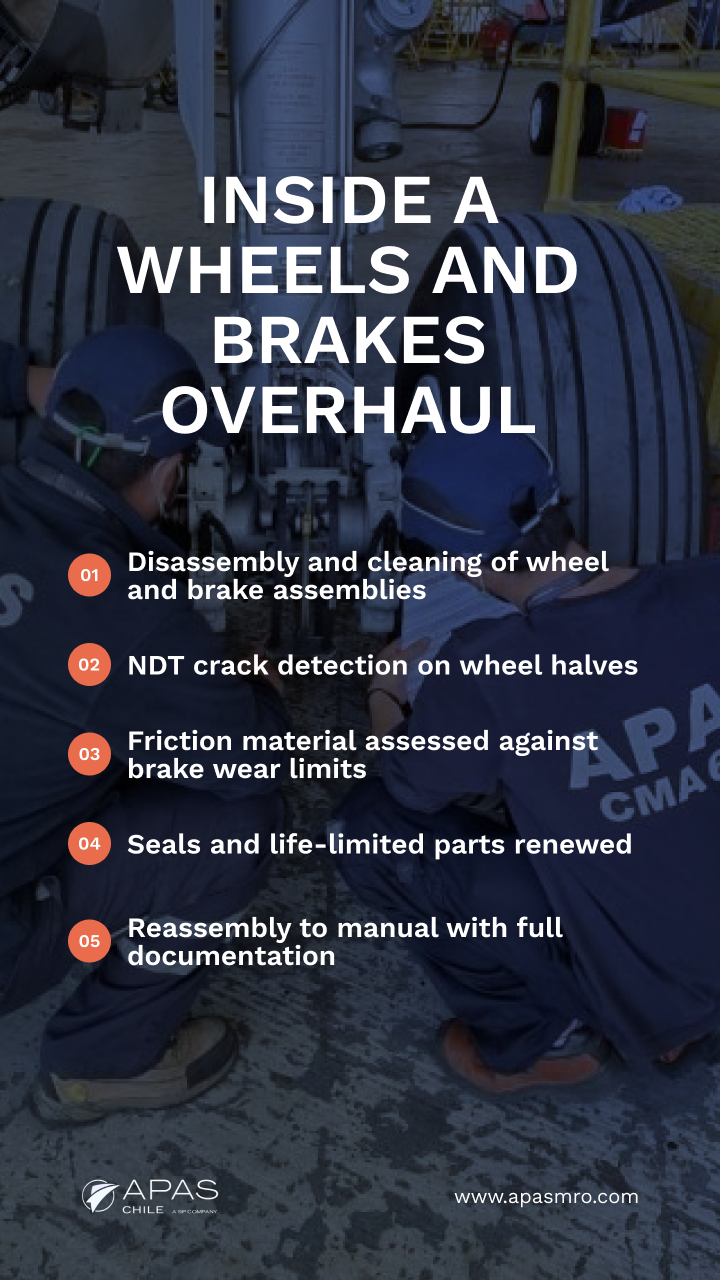
An aircraft wheels and brakes overhaul includes full disassembly, cleaning, inspection of bearings and wheel halves, non-destructive testing for cracks, assessment of friction material against brake wear limits, replacement of seals and life-limited parts, and reassembly to the manufacturer's manual with complete documentation.
How does an aircraft brake overhaul protect dispatch reliability?
A planned aircraft brake overhaul replaces worn friction material and seals before they cause an on-aircraft problem, so brakes are changed during a scheduled window rather than triggering an unscheduled removal at the gate. This keeps serviceable units flowing and reduces brake-driven delays.
What does wheel inspection at an MRO involve beyond a ramp check?
Wheel inspection at an MRO adds non-destructive testing of the wheel halves, bearing condition checks, corrosion and fastener verification, and pressure-component validation. It goes well beyond the visual walk-around done on the ramp, to confirm structural integrity.
How are brake wear limits used to plan maintenance?
Brake wear limits define how much friction material can be consumed before overhaul is required. Wear readings taken during line checks are trended so a brake change can be planned into a maintenance window, keeping tire and brake maintenance predictable instead of reactive.
Does APAS Chile have a wheels and brakes shop in Santiago?
Yes. APAS Chile operates a wheels and brakes shop as part of its integral MRO in Santiago, supported by in-house NDT, engineering and quality oversight, and SIP Holding inventory and a bonded warehouse for parts availability.
Need Critical Parts Support—Now?
Our AOG response team is standing by 24/7 to source, quote, and dispatch the components you need.