MRO Aviation: What an MRO Does and Who Decides the Work
An aviation MRO does four jobs: line maintenance, heavy checks, shop work and the release to service. When each one happens, and who at the airline decides.
What Does an MRO Do? The Work, the Timing, and Who Decides
In aviation, an MRO — a maintenance, repair and overhaul organization — is the certified facility that carries out the work an operator has decided its aircraft needs, and then signs that the aircraft, or the part, can return to service. The decision and the signature sit in two different places. The airline owns the first. The MRO owns the second, and only for the work its approvals cover.
Most explanations leave that split out and list what an MRO does as if it were a menu. For anyone keeping a fleet flying, the practical question is different: when does each kind of work appear in an aircraft's life, and who inside the airline decides it?
What MRO means in aviation, and what it does not
In aviation, MRO means the work itself — maintenance, repair and overhaul — performed by an organization an aviation authority has approved. Search the term and much of what comes back describes something else: factory supplies, or a physician who reviews drug tests.
US regulations define maintenance as inspection, overhaul, repair, preservation and the replacement of parts. What separates an aviation MRO from any capable workshop is the approval: it turns a repair into a legal release.
The four jobs of an aviation MRO, and when each one appears
An aviation MRO does four distinct jobs. Each appears at a different moment in an aircraft's life, and each is decided on a different clock.
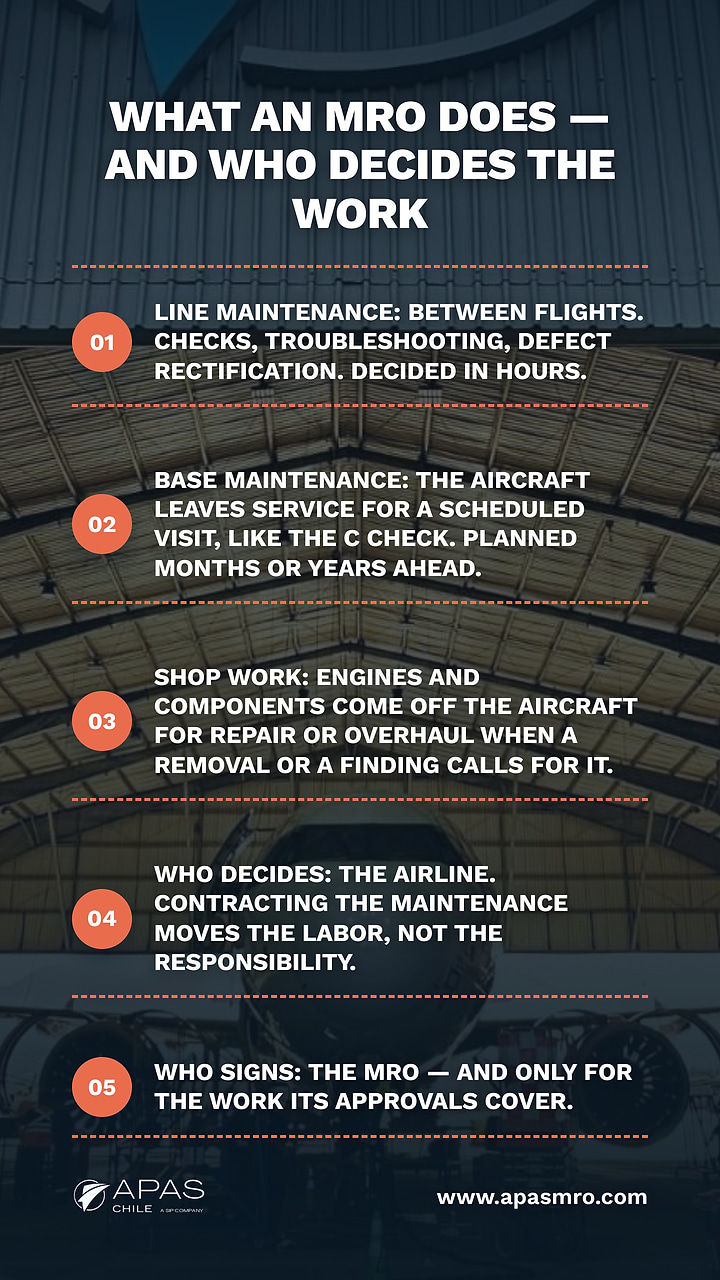
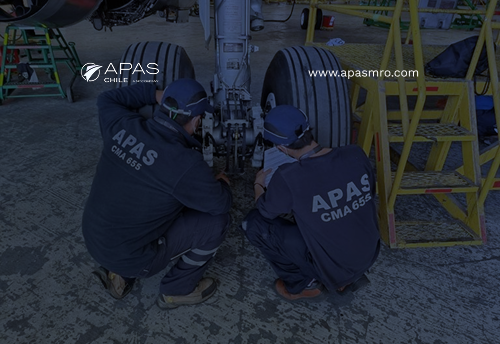
Line maintenance happens between flights, on every day the aircraft operates: transit and daily checks, troubleshooting, defect rectification. What line maintenance decides before each departure is measured in hours.
Base maintenance, also called heavy maintenance, happens when the aircraft is withdrawn from service for a scheduled visit. The C check, with its scope and timeline, is the best-known example, and it is planned months or years ahead.
Shop work is the repair and overhaul of what comes off the aircraft — engines and components — whenever a removal or a finding calls for it. Where those shops sit changes how long the aircraft waits.
Certification of the work closes each of the other three: a release to service, signed by someone the authority has authorized to sign it.
Job
What it covers
When it is decided
Who typically decides at the airline
Line maintenance
Pre-flight and transit checks, troubleshooting, defect rectification, minor repairs
Hours before the next departure
Maintenance control, on shift
Base (heavy) maintenance
Scheduled checks such as the C check, structural inspections, modifications
Months to years ahead, from the maintenance program
Maintenance planning and technical services
Shop work
Repair and overhaul of removed engines and components
When a removal or a finding requires it
Powerplant and component engineering, with materials
Certification of the work
The release to service of the aircraft or the part
At the end of every job, before the aircraft or part returns to use
For contracted work, the MRO that performs it signs the release, and the airline accepts it
Line maintenance vs. base maintenance: where the boundary sits
The boundary between line and base maintenance is set by the depth of the work and by whether the aircraft can stay in service while it is done. European rules describe line maintenance as any maintenance carried out before flight to make sure the aircraft is fit for the intended flight — limited work done while the aircraft stays in its operating environment. Everything else is base maintenance.
The same rules let each maintenance organization decide where a task falls, weighing its expected duration, the number of tasks, the shifts and the disciplines involved. For the airline the consequence is time: a line task competes with the next departure, and a base task competes with the slot. The planning differences between the two are covered in how heavy maintenance is planned.
Who decides the maintenance, and who signs the release
The airline decides what maintenance its aircraft need and when; the MRO carries it out and certifies it. Under US rules, an air carrier remains primarily responsible for the airworthiness of its aircraft even when another organization performs the work. Contracting the maintenance moves the labor, not the responsibility.
What the airline decides comes from its approved maintenance program: which tasks are due, at which interval, in which visit. What it cannot decide in advance is what the aircraft will reveal once it is opened. That is the moment the MRO's role changes from executing a work package to proposing one — a finding, an extra task, sometimes a new date — which the airline still has to accept. It is also why a release date is committed before anyone has seen inside the aircraft.
The signature belongs to the MRO. A certificated repair station may approve for return to service the work it is rated for, and it may not maintain what it is not rated for — nor work that needs technical data, equipment or facilities it does not have. That clause is the real definition of an MRO's scope: not what the facility says it can do, but what its approvals allow it to release.
What an MRO's approvals say about its scope
An MRO's approvals define which aircraft it can release, for which registries, and in which classes of work. A national approval covers aircraft on that country's register; a foreign approval, such as an FAA repair station certificate, extends the same facility to operators under that authority. Ratings then narrow the scope by airframe, powerplant or accessories.
APAS Chile, for instance, works under DGAC Chile approval CMA-655 and an FAA repair station certificate, among other Latin American approvals. What each of those approvals means for a fleet is explained separately.
Frequently asked questions
What is the difference between an MRO and an OEM?
The original equipment manufacturer designs and builds the aircraft, engine or component and publishes the data used to maintain it. The MRO uses that data to maintain, repair and overhaul it after delivery.
What is the difference between an MRO and an FBO?
A fixed-base operator provides airport services — fuel, handling, hangar space — mostly for business and general aviation. An MRO performs certified maintenance; an FBO can only do so under its own maintenance approval.
What is a Part 145 repair station?
It is a maintenance organization certificated by the FAA under 14 CFR Part 145. Its certificate lists ratings — airframe, powerplant, propeller, radio, instrument and accessory — and it can only release work within them.
Does the airline or the MRO perform the C check?
Either can. In both cases the airline schedules the check from its maintenance program, and the organization that performs it signs the release.
Aviation MRO as a sequence of decisions
An MRO is easier to understand as a sequence of decisions than as a list of services. The airline decides, on four different clocks; the MRO executes, proposes when the aircraft reveals something new, and signs only what its approvals cover.
For A320 and 737 operators in Latin America, the next step is to see those four jobs organized in one place: the MRO services at Santiago International Airport cover line, base, shop and NDT work for narrow-body fleets.
Need Critical Parts Support—Now?
Our AOG response team is standing by 24/7 to source, quote, and dispatch the components you need.