FAA & DGAC CMA-655 Certification — What It Means for Your Fleet
When an operator chooses where to send an aircraft for maintenance, the conversation almost always starts with capability — can this facility do the work?…
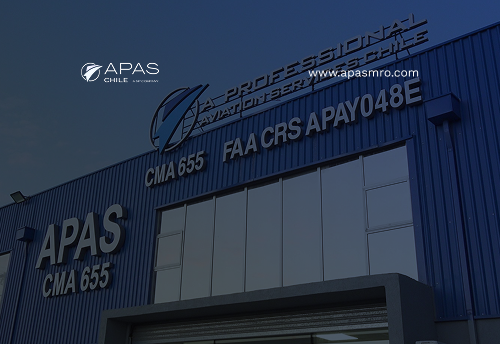
When an operator chooses where to send an aircraft for maintenance, the conversation almost always starts with capability — can this facility do the work? But the more important question, the one that protects the fleet over time, is quieter: can the work be trusted, and can it be proven? That is what certifications are for. They are the shared language of trust in aviation maintenance — a way for an operator to know, before the first panel is opened, that a facility is held to a recognized standard and audited against it. For APAS Chile in Santiago (SCL), that language is spoken in two dialects at once: FAA and DGAC CMA-655. Here is what each one means and why holding both matters for your fleet.
What FAA certification represents
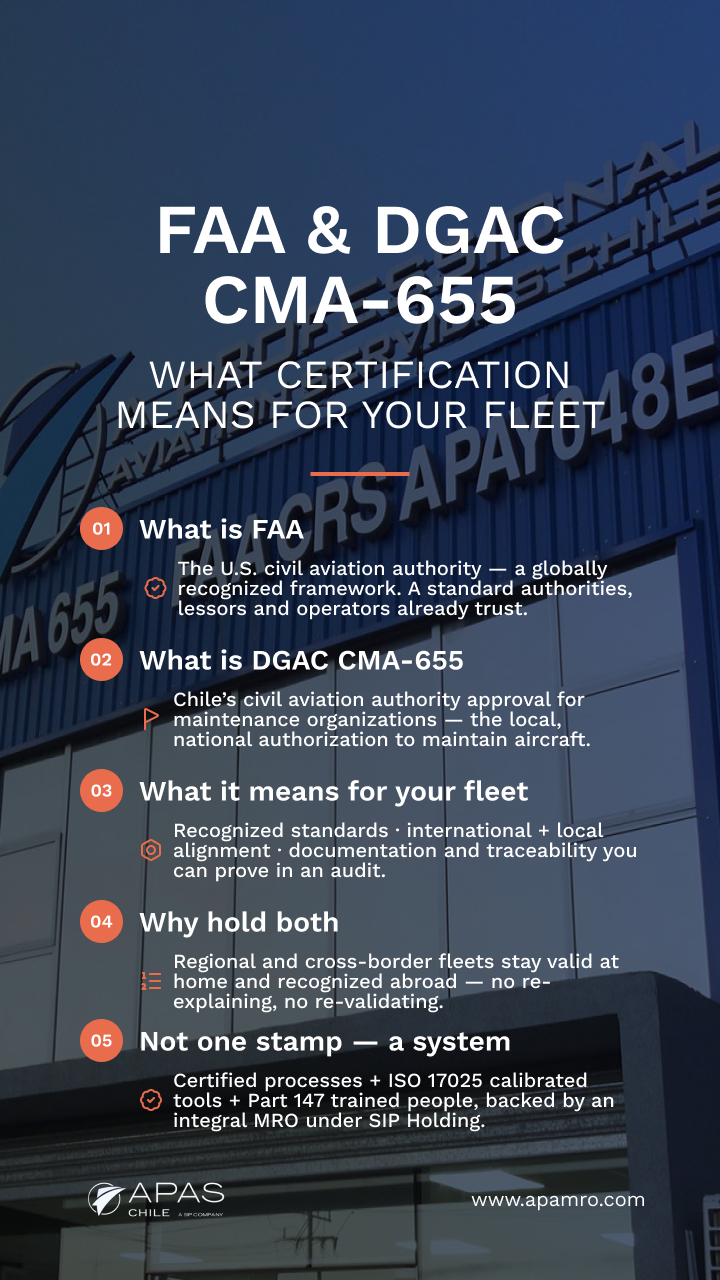
The FAA is the civil aviation authority of the United States, and its regulatory framework is one of the most widely recognized reference points in the world. When a maintenance organization operates under an FAA framework, it means the facility’s processes, records, and quality controls are built to a standard that authorities, lessors, and operators across many markets already understand and accept. For an operator, that recognition is practical: it reduces the friction of explaining or re-validating a facility’s credentials, because the standard behind them is a known quantity. FAA recognition doesn’t describe a single task — it describes a way of working that is documented, controlled, and accountable.
What DGAC CMA-655 represents
The DGAC (Dirección General de Aeronáutica Civil) is Chile’s civil aviation authority. CMA-655 is the DGAC’s approval framework for maintenance organizations — the local, national authorization that says a facility is qualified to maintain aircraft under Chilean regulation. For any operator flying within or through the region, this matters directly: it means the maintenance is aligned with the authority that governs the airspace and the fleet locally. A DGAC CMA-655 approval is not a formality bolted onto an international credential; it is the regulatory foundation that makes the work valid and recognized at home.
What it means to hold both
Holding FAA and DGAC CMA-655 together is more than collecting two logos. It signals that a facility’s single quality system can satisfy an internationally recognized framework and the national authority at the same time — without running two disconnected ways of working. For the operator, the value shows up in three concrete places:
Recognized standards — the work is performed and documented according to frameworks that authorities and stakeholders already trust, so credibility travels with the aircraft.
International and local alignment — the maintenance answers to both a globally recognized reference (FAA) and the Chilean authority (DGAC CMA-655), covering fleets that operate across borders and at home.
Documentation and traceability — certified organizations are built around records: what was done, by whom, against which standard, and with what parts and calibrated tools. That paper trail is what turns good work into provable work.
That last point is where certifications become tangible. Traceability is the difference between saying an aircraft was maintained correctly and being able to demonstrate it — on demand, in an audit, or during a lease transition.
Why this matters for regional and demanding-market operators
For regional operators, dual recognition removes a real headache: work done under a locally approved and internationally recognized framework doesn’t need to be re-explained or re-validated every time an aircraft crosses a border or changes hands. For operators serving demanding markets — where lessors, insurers, and oversight authorities expect clean, complete, standards-based documentation — the same recognition is what keeps records defensible. When an audit or a lease return comes, the questions are easier to answer because the standard was already built into the work, not reconstructed afterward.
Certification as an ecosystem, not a single stamp
At APAS Chile, these approvals sit alongside a broader quality foundation: ISO 17025-certified calibration — so the tools measuring your aircraft are themselves verified — and a Part 147 Training Center, which supports the qualification of the people doing the work. Certified processes, certified measurement, and trained personnel reinforce one another. Together, backed by an integral MRO approach under SIP Holding, they mean an operator isn’t trusting a single credential; they’re trusting a system designed to be recognized and provable at every layer.
The bottom line
Certifications are how trust is made legible in aviation maintenance. FAA recognition brings a globally understood standard; DGAC CMA-655 brings the Chilean authority’s approval; together they give an operator internationally aligned, locally valid, fully documented work — the kind that holds up when it’s examined. For a fleet, that isn’t a nice-to-have. It’s the assurance that the maintenance behind every dispatch can be trusted and proven.
What is the DGAC CMA-655 certification, and what does it mean for my fleet?
The DGAC (Dirección General de Aeronáutica Civil) is Chile's civil aviation authority, and CMA-655 is its approval framework for maintenance organizations, the national authorization that says a facility is qualified to maintain aircraft under Chilean regulation. For any operator flying within or through the region, it means the maintenance is aligned with the authority that governs the airspace and fleet locally. It is the regulatory foundation that makes the work valid and recognized at home.
What does working with an FAA-certified MRO in Chile represent?
The FAA is the civil aviation authority of the United States, and its framework is one of the most widely recognized reference points in the world. When a maintenance organization operates under an FAA framework, its processes, records, and quality controls are built to a standard that authorities, lessors, and operators across many markets already understand and accept. That recognition reduces the friction of explaining or re-validating a facility's credentials, because the standard behind them is a known quantity.
Why does holding both FAA and DGAC aviation certifications matter for cross-border operators?
Holding both together signals that a single quality system can satisfy an internationally recognized framework and the national authority at the same time, without running two disconnected ways of working. For regional and cross-border fleets, dual recognition means work doesn't need to be re-explained or re-validated every time an aircraft crosses a border or changes hands. Credibility travels with the aircraft, at home and abroad.
How do MRO certifications support documentation and traceability for a fleet?
Certified organizations are built around records: what was done, by whom, against which standard, and with what parts and calibrated tools. That paper trail is what turns good work into provable work. When an audit or a lease return comes, the questions are easier to answer because the standard was already built into the work rather than reconstructed afterward.
Beyond certification, how do calibration and Part 147 training center capability fit into aviation quality certification at APAS Chile?
At APAS Chile, these approvals sit alongside a broader quality foundation, including calibration so the tools measuring your aircraft are themselves verified, and a Part 147 Training Center that supports qualifying the people doing the work. Certified processes, verified measurement, and trained personnel reinforce one another. Backed by an integral MRO approach under SIP Holding, an operator isn't trusting a single credential but a system designed to be recognized and provable at every layer.
Need Critical Parts Support—Now?
Our AOG response team is standing by 24/7 to source, quote, and dispatch the components you need.