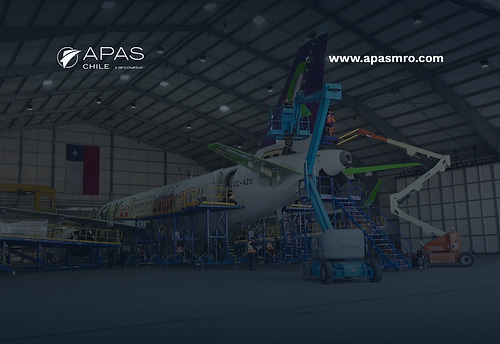
How Line Maintenance Determines Dispatch Readiness & Prevents Delays Before They Occur
Line maintenance is the critical decision point before every flight. Learn how real-time inspections, MEL compliance, and rapid troubleshooting prevent delays.
How Line Maintenance Determines Dispatch Readiness & Prevents Delays Before They Occur
Introduction: The Technical Checkpoint Before Departure
Line maintenance is one of the most important technical checkpoints in daily aircraft operations.
While base maintenance focuses on scheduled inspections and heavier maintenance events, line maintenance supports aircraft readiness in real time, often within short turnaround windows. It is where technicians inspect, troubleshoot, service, document, and release maintenance actions so the aircraft can continue operating safely and efficiently.
For airlines and operators, this work directly affects dispatch readiness. A fluid leak, worn tire, warning indication, cabin defect, or unresolved logbook entry can quickly become a delay if it is not assessed and managed correctly.
Many time-sensitive maintenance decisions are made on the ramp, where technical assessment, documentation, MEL compliance, maintenance control, and operations must align within the available ground time.
This is where airworthiness becomes operational.
What Is Line Maintenance in Aviation?
Line maintenance includes routine maintenance activities performed at the gate, ramp, or line station to support aircraft operation between scheduled maintenance events.
Unlike base maintenance, which typically involves planned inspections and heavier work in hangars, line maintenance is performed closer to active flight operations and often under short turnaround constraints.
Typical line maintenance tasks may include:
Pre-flight and post-flight walkaround inspections
Approved servicing tasks such as oil, hydraulic fluid, oxygen, nitrogen, or other aircraft-specific servicing requirements
Visual inspection of landing gear, tires, brakes, control surfaces, doors, panels, and engine areas
Troubleshooting of crew-reported discrepancies
Minor defect rectification
Replacement of approved line-replaceable components
MEL compliance checks and deferral support
Aircraft logbook review and maintenance documentation
Release-to-service actions after completed maintenance work
Line maintenance is both time-sensitive and safety-sensitive. The objective is to support on-time operation, but never at the expense of regulatory compliance or airworthiness.
The certifying technician plays a critical role in confirming that maintenance actions have been completed and released in accordance with approved procedures.
How Does Line Maintenance Reduce Delays Before Departure?
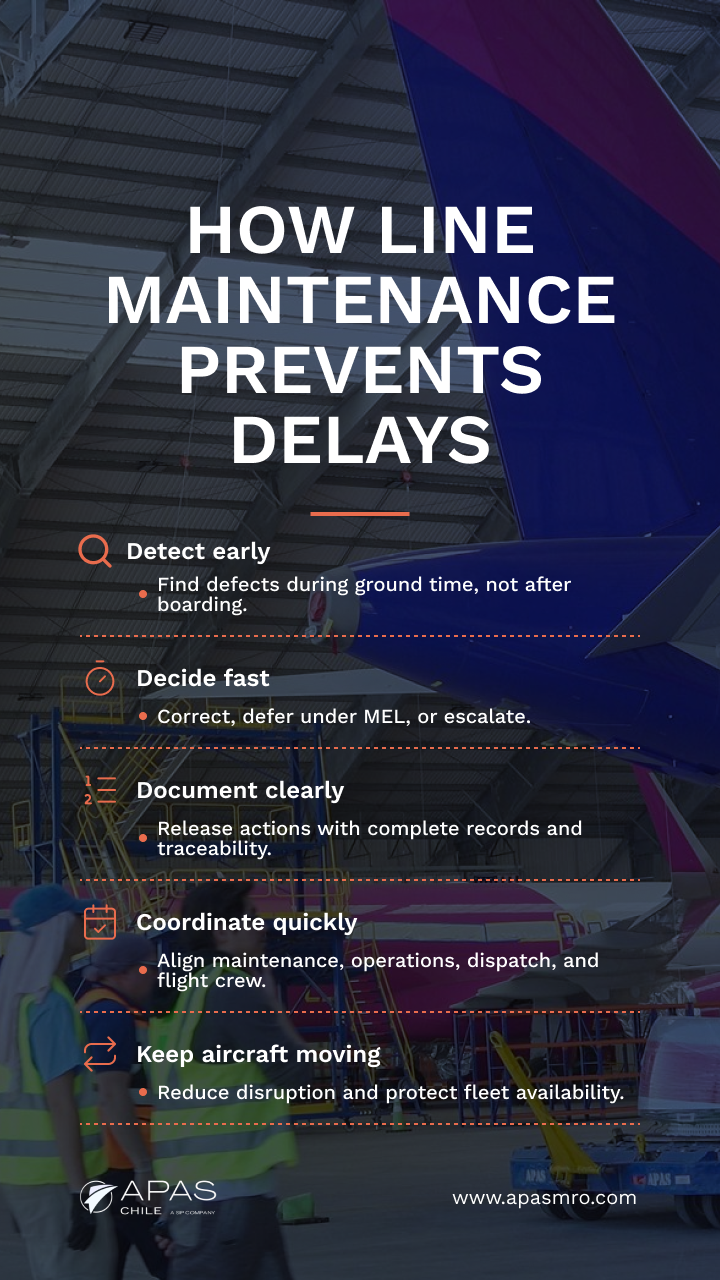
Line maintenance helps prevent delays by detecting and addressing discrepancies early, before they become departure-blocking issues.
During a walkaround inspection or logbook review, technicians may identify findings such as:
Hydraulic leaks
Tire wear or brake concerns
Panel or door damage
Warning indications
Cabin defects
Fluid servicing needs
Minor component failures
Crew-reported discrepancies
The value of line maintenance is not only in identifying the issue, but in quickly determining the correct next step.
The line maintenance team must assess whether the finding can be corrected immediately, deferred under the operator’s approved Minimum Equipment List, escalated to maintenance control, or handled through additional troubleshooting.
When that decision happens early in the turnaround window, operators have more time to act. When it happens late, the same issue can create boarding delays, gate delays, missed slots, or aircraft-on-ground situations.
Proactive line maintenance reduces disruption by addressing findings during scheduled ground time instead of discovering them during taxi, after boarding, or at the moment of dispatch.
The Real-Time Decision Workflow: From Finding to Operational Readiness
The line maintenance decision workflow operates under time pressure, but it cannot compromise airworthiness or compliance.
1. Inspect the aircraft
The process begins with a visual and technical review of the aircraft condition. This may include walkaround inspection, logbook review, crew communication, system checks, and verification of scheduled line tasks.
The objective is to detect visible damage, abnormal conditions, servicing requirements, or open defects before departure.
2. Assess the finding
When a discrepancy is found, the line maintenance team evaluates its operational and airworthiness impact.
Key questions include:
Does the defect affect dispatch?
Can it be corrected within the available ground time?
Is troubleshooting required?
Is the affected system covered by the MEL?
Are parts, tools, and qualified personnel available?
Does maintenance control need to be involved?
This assessment is where technical judgment becomes critical. The wrong decision can either delay an aircraft unnecessarily or create compliance risk.
3. Correct, defer, or escalate
Once the finding has been assessed, the team follows the approved path.
If the issue can be corrected on the line, technicians perform the required maintenance action, replacement, servicing, or adjustment.
If the issue cannot be corrected immediately but is covered by the operator’s approved MEL, dispatch may be permitted only under the specified conditions, operational or maintenance procedures, placarding requirements, and repair intervals.
If the issue is outside line maintenance scope, requires deeper troubleshooting, or affects airworthiness in a way that cannot be deferred, the aircraft may need to be escalated for additional maintenance action.
4. Document and release the maintenance action
After corrective action or approved deferral, documentation is completed in the aircraft records.
This documentation may include:
The defect found
The maintenance action performed
Parts or components replaced
Testing or operational checks completed
MEL reference, if applicable
Required placards or operational limitations
Required repair interval or follow-up action
Release-to-service signature for the maintenance performed
After corrective action or approved deferral is completed and recorded, the maintenance action can be released. The operator then continues the dispatch process according to its approved procedures.
This distinction matters: release-to-service confirms the maintenance action performed; dispatch readiness depends on the broader coordination of maintenance, operations, dispatch, and flight crew.
5. Coordinate with operations
Line maintenance does not work in isolation.
Technicians, maintenance control, operations, dispatch, and flight crew must coordinate quickly so the aircraft can continue through the departure process.
This coordination is what turns technical resolution into operational readiness.
MEL Compliance in Line Maintenance
The Minimum Equipment List is one of the most important tools in line maintenance.
The MEL allows an aircraft to be dispatched with certain inoperative items, but only under specific approved conditions. It is not a shortcut, and it is not a general permission to fly with unresolved defects.
A proper MEL process requires:
Correct identification of the affected item
Verification that the item is covered by the MEL
Compliance with all operational and maintenance procedures
Placarding when required
Clear documentation in the aircraft records
Tracking of repair intervals
Communication with flight crew and operations
For example, a non-critical system may be deferred if the aircraft has redundancy, required procedures are followed, and the operator’s approved MEL permits dispatch under defined conditions.
These deferrals are not safety shortcuts. They are regulated provisions that balance airworthiness, safety margins, and operational availability.
How Does Line Maintenance Improve Aircraft Availability?
Aircraft availability depends on more than scheduled maintenance planning. It also depends on how efficiently daily findings are handled on the line.
A single unresolved component, warning indication, or documentation issue can remove an aircraft from service.
Effective line maintenance improves fleet availability by:
Detecting defects before they interrupt departure
Completing minor rectification during scheduled ground time
Supporting MEL decisions when allowed
Coordinating quickly with maintenance control and operations
Reducing unnecessary escalation to base maintenance
Ensuring that documentation is complete before dispatch
This is especially important in high-utilization environments, where aircraft have limited ground time and delays can affect multiple rotations.
When line maintenance is well organized, it helps operators protect aircraft turnaround time, reduce operational disruption, and keep fleets moving.
Operational Metrics: Measuring Line Maintenance Performance
Line maintenance performance should be measured through operational metrics that reflect speed, reliability, and quality.
Useful indicators include:
Maintenance delay rate: how often maintenance findings affect departure
Dispatch reliability: the percentage of flights operating without maintenance-related delays
Turnaround impact: whether maintenance activity extends scheduled ground time
Defect rectification time: how quickly findings are resolved on the line
MEL deferral quality: whether deferrals are properly documented, tracked, and closed within required intervals
Repeat defects: whether the same issue returns after previous maintenance action
Escalation rate: how often line findings must move to deeper maintenance or base maintenance
These metrics help operators and MRO providers identify where delays are created.
A high repeat-defect rate may indicate incomplete troubleshooting. A high escalation rate may point to parts availability, tooling, or training gaps. Frequent MEL extensions may suggest deeper planning issues.
The goal is not only to work faster. The goal is to make better technical decisions earlier.
Line maintenance is faster when component support is close, organized, and certified.
Many line findings depend on the availability of serviceable components, approved replacements, repair capability, and proper documentation. If a faulty valve, sensor, actuator, light assembly, pump, or other line-replaceable component is not available, a small defect can become an extended delay.
Integrated component support helps line maintenance teams by:
Providing faster access to serviceable units
Reducing dependency on distant suppliers
Supporting repair-versus-replace decisions
Improving control over documentation and traceability
Reducing logistics delays
Helping restore aircraft availability more efficiently
When local inventory, certified repair capability, and documentation processes are available, this can reduce lead time compared with waiting for external vendor coordination.
For APAS Chile, this connection between line maintenance and component-level support is especially important. Line maintenance decisions often depend on whether the right component, technical data, documentation, and repair pathway are available at the right time.
In practice, the speed of line maintenance is often limited not by the inspection itself, but by the availability of the next technical step.
Line Maintenance Challenges in Chile and Latin America
Line maintenance in Chile and Latin America can involve specific operational challenges.
Operators may need to manage aircraft across different airports, countries, regulatory environments, and logistics conditions. Parts availability, customs timing, documentation, and coordination with local civil aviation authorities can all affect turnaround time.
Common challenges include:
Limited access to certain components at remote stations
Longer logistics lead times for imported parts
Coordination across multiple operating locations
Regulatory documentation requirements
Need for qualified technicians across different aircraft types
Pressure to maintain fleet availability despite tight schedules
Coordinating across local civil aviation authorities, operator requirements, and applicable FAA/EASA frameworks where relevant requires strong documentation discipline and audit readiness.
These challenges make local capability important.
A line maintenance provider with regional knowledge, certified processes, technical coordination, and access to component support can help operators reduce uncertainty and maintain more predictable operations.
For APAS Chile, the value is not only performing maintenance tasks. It is helping operators manage the operational reality of keeping aircraft available in a complex regional environment.
Why Line Maintenance Requires Planning, Not Just Reaction
Line maintenance is often associated with urgent troubleshooting, but strong line maintenance depends on planning.
Operators and MRO providers can improve line maintenance outcomes by preparing in advance:
Reviewing recurring defects
Positioning high-use components strategically
Coordinating with maintenance control
Planning scheduled line tasks during longer ground windows
Training technicians on common aircraft and system issues
Improving communication between operations and maintenance teams
Using data to identify delay patterns
The more predictable the line maintenance environment becomes, the fewer decisions need to be made under pressure.
This is where maintenance planning and operational efficiency meet. A well-prepared line maintenance operation can resolve findings faster because the process, people, parts, and documentation are already aligned.
FAQs
What tasks are included in line maintenance?
Line maintenance may include walkaround inspections, logbook review, approved servicing tasks, minor defect rectification, operational troubleshooting, MEL compliance verification, component replacement, and release-to-service documentation after maintenance actions.
What is the difference between line maintenance and base maintenance?
Line maintenance is performed at the gate, ramp, or line station to support active aircraft operations. It usually addresses routine checks, troubleshooting, servicing, and minor corrective actions.
Base maintenance is more extensive and usually takes place in a hangar. It may include heavy checks, structural inspections, major repairs, and deeper scheduled maintenance tasks.
How does line maintenance reduce aircraft delays?
Line maintenance reduces delays by identifying and addressing technical findings before departure. It allows technicians to correct minor issues, coordinate MEL decisions when permitted, and communicate quickly with maintenance control and operations.
What is MEL compliance in line maintenance?
MEL compliance means following the operator’s approved Minimum Equipment List when an item is inoperative. The MEL defines whether dispatch is allowed, under what conditions, what procedures must be followed, and how long the item may remain deferred.
How can operators improve aircraft turnaround time?
Operators can improve turnaround time by strengthening technician training, positioning critical components, improving communication between maintenance control and operations, tracking recurring defects, and coordinating scheduled line tasks during appropriate ground windows.
Why is component support important for line maintenance?
Component support is important because many delays depend on whether a serviceable replacement is available. Faster access to approved components, repair capability, documentation, and traceability helps line maintenance teams resolve findings more efficiently.
Conclusion: Dispatch Confidence Is Built on the Line
Line maintenance is where daily aircraft readiness is confirmed.
Every inspection, troubleshooting decision, MEL assessment, component replacement, and release-to-service action affects whether an aircraft can continue operating safely and on schedule.
For operators, the difference between a delay and an on-time departure is often shaped before pushback, during the line maintenance process.
Effective line maintenance requires more than speed. It requires technical judgment, regulatory discipline, component support, maintenance planning, and clear coordination between maintenance control, operations, and flight crew.
For APAS Chile, line maintenance is part of a broader commitment to helping operators maintain aircraft availability, reduce operational disruption, and keep fleets moving with confidence.
Need Critical Parts Support—Now?
Our AOG response team is standing by 24/7 to source, quote, and dispatch the components you need.