Component Repair & Shops
Bonded Warehouse & AOG in the Southern Cone: Logistics That Cut Downtime
When an aircraft is on ground, the clock is the enemy. Every hour of unplanned downtime carries a cost — in disrupted schedules, displaced crews,…

Component Repair & Shops
When an aircraft is on ground, the clock is the enemy. Every hour of unplanned downtime carries a cost — in disrupted schedules, displaced crews,…
When an aircraft is on ground, the clock is the enemy. Every hour of unplanned downtime carries a cost — in disrupted schedules, displaced crews, re-accommodated passengers, and idle capital. Yet operators who have lived through an AOG in South America know a hard truth: very often the delay is not caused by the repair itself. The technical fix may be understood within hours. What stretches the aircraft on ground for days is frequently the logistics — sourcing the part, shipping it across borders, and clearing it through customs. In the Southern Cone, that logistics friction is where downtime is won or lost.
Consider a common scenario. A component fails on an aircraft operating in the region. The MRO diagnoses the issue quickly and knows exactly which part is required. But if that part sits in an inventory thousands of kilometres away, the aircraft now waits on international freight, brokerage, and import clearance before a technician can even begin. Customs procedures, documentation, duties, and handoffs between multiple parties can add days that have nothing to do with maintenance skills. For a regional operator, this is the invisible cost of thin local support: the technical answer is close, but the part is not.
A bonded warehouse (bodega aduanera) is a customs-authorized facility where imported goods can be stored under customs control without duties and import taxes being triggered at the moment of arrival. Charges are settled only when the goods are formally released for local use. For aviation, that structure is powerful for a few reasons:
In other words, a bonded warehouse converts a cross-border sourcing problem into a local availability question. That is the difference between an aircraft waiting on freight and an aircraft waiting on a work slot.
Distance is not neutral. An operator flying routes across Chile, Argentina, and the wider Southern Cone benefits when support sits within the same region rather than at the end of a long intercontinental supply line. Santiago (SCL) is a strategically located hub in South America, well connected for both aircraft movements and freight. A support model anchored in SCL keeps parts, expertise, and the aircraft within a tighter geographic loop — shortening the physical and administrative journey a component has to make before it is installed.
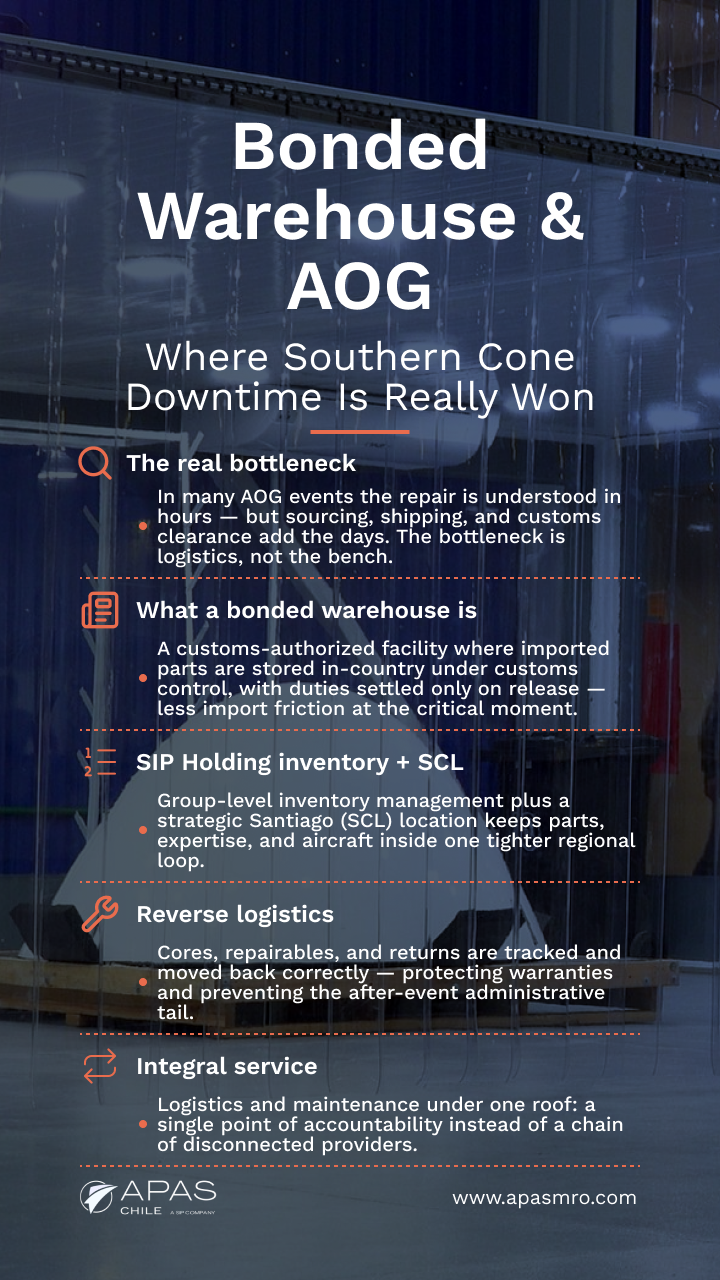
APAS Chile is an integral MRO backed by SIP Holding, and that backing matters most precisely in AOG situations. Group-level inventory management means material can be sourced and coordinated through a broader network rather than a single isolated stockroom. Combined with a bonded warehouse in Chile and a strategic SCL location, this gives regional operators something that is hard to assemble piece by piece: parts availability, customs structure, and maintenance capability under one integral service. Instead of stitching together a broker, a freight forwarder, a parts supplier, and a separate maintenance provider, the operator works with a single point of accountability.
Getting the aircraft flying is only half of a well-run AOG event. Serviceable cores, repairable units, and returns still have to move back through the chain — documented, tracked, and returned or overhauled correctly. Reverse logistics is the discipline of managing that flow. Handled well, it protects component warranties and exchange programs, keeps inventory honest, and prevents the after-event administrative tail from becoming its own source of delay and cost. It is a quiet capability that separates a complete logistics service from a simple parts sale.
Downtime is rarely a pure engineering problem. In the Southern Cone it is very often a logistics problem wearing an engineering face. A bonded warehouse close to the operation, backed by SIP Holding inventory, anchored in Santiago (SCL), and closed out with proper reverse logistics, attacks the part of AOG that most regional operators underestimate: the distance between "we know what it needs" and "the part is here." That is where hours — and cost — are recovered.
Facing an AOG, or planning so the next one costs you less? Contact us to talk through how integral MRO and bonded logistics in Chile can keep your fleet moving.
A bonded warehouse (bodega aduanera) is a customs-authorized facility where imported goods can be stored under customs control without duties and import taxes being triggered at the moment of arrival; charges are settled only when the goods are formally released for local use. For aviation, this keeps parts already in-country and pre-positioned near the operation, with less import friction at the critical moment. It converts a cross-border sourcing problem into a local availability question.
Operators who have lived through an AOG in South America know the technical fix may be understood within hours, while what stretches the aircraft on ground for days is frequently the logistics. Sourcing the part, shipping it across borders, and clearing customs, along with documentation, duties, and handoffs between multiple parties, can add days that have nothing to do with maintenance skill. In the Southern Cone, that logistics friction is where downtime is won or lost.
A fresh international import under AOG pressure has to move through freight, brokerage, and import clearance before a technician can even begin. Because material in a bonded warehouse is already inside a controlled customs environment, the release process is more streamlined than a fresh import. When the part is physically present and ready, the conversation shifts from "when will it ship?" to "when can we fit it."
APAS Chile is an integral MRO backed by SIP Holding, and that backing matters most in AOG situations. Group-level inventory management means material can be sourced and coordinated through a broader network rather than a single isolated stockroom, and Santiago (SCL) is a strategically located hub, well connected for both aircraft movements and freight. Combined with a bonded warehouse in Chile, this keeps parts, expertise, and the aircraft within a tighter regional loop.
Getting the aircraft flying is only half of a well-run AOG event; serviceable cores, repairable units, and returns still have to move back through the chain, documented, tracked, and returned or overhauled correctly. Handled well, reverse logistics protects component warranties and exchange programs, keeps inventory honest, and prevents the after-event administrative tail from becoming its own source of delay. With logistics and maintenance under one integral service, the operator works with a single point of accountability instead of stitching together separate providers.
Our AOG response team is standing by 24/7 to source, quote, and dispatch the components you need.
Request a Quote Now