Engineering, Quality & Certifications
Lease Return Checks: What Must Close Before Redelivery
Lessor, operator and MRO each hold part of the proof at redelivery. What each one needs, where the gaps open and how early to start the work.


Engineering, Quality & Certifications
Lessor, operator and MRO each hold part of the proof at redelivery. What each one needs, where the gaps open and how early to start the work.
A lease return check is the set of inspections and records reviews that prove an aircraft meets the condition its lease requires on the day it goes back to the lessor. It is less a check than a closure of evidence: the aircraft has to be airworthy, match what the contract says, and be backed by records that prove both.
Many operators treat redelivery as one more maintenance event. It reads better as a handover between three parties, each holding a different part of the proof, and the three can sit in different countries.
No, and mixing them up hides where a redelivery is really stuck. In its October 2026 issue, AviTrader MRO 360° asked maintenance professionals about redelivery after a heavy check, when the MRO hands the aircraft back to its customer. One of them separates two things: customer acceptance, commercial closeout, disputes over man-hours and payment issues can delay the contractual handover, but they are separate from the aircraft's technical readiness. Technical release can happen only once all required maintenance is completed, properly certified and compliant with approved data and regulation.
The same split applies at the end of a lease. The technical release is the first gate, and it belongs to the MRO. Why a physically finished aircraft can still miss it is covered in what holds an aircraft in the hangar after the work is done.
The second gate belongs to the lease. Acumen points out that an aircraft can be airworthy and still fail specific lease return conditions, and that vague wording such as "fair wear and tear" or "good operating condition" means different things to lessor and lessee. The contract sets the standard, not the maintenance manual.
The operator's matrix is the working tool. Air Tech Consulting recommends building it before the physical inspection begins, with six columns: the contractual return condition, the current aircraft status, the evidence available, the gap owner, the corrective action and the due date. It becomes the control document for the whole transition.
Earlier than most plans assume. Advisers put the start between 12 and 24 months before redelivery. The first months go to the contract: reading the return conditions line by line and comparing them with where the aircraft will be at return. Records come next, because a physical inspection can move quickly but a records cleanup often cannot. Around six months out, according to Acumen, inspection planning, MRO slots, workscopes and records preparation should already be active.
The same logic is reaching the software market. A records-management company interviewed by AviTrader says its tool compares what the maintenance planning system says should exist with the compliance documents actually held, so a gap is found "much earlier" than "during an audit or at the end of a lease." A lease-management platform launched in 2026 brings return-condition forecasting into the same view as maintenance and traceability records, the company said. They are vendor statements, not tests, but they point the same way as the advisers: close evidence continuously, not at the end.
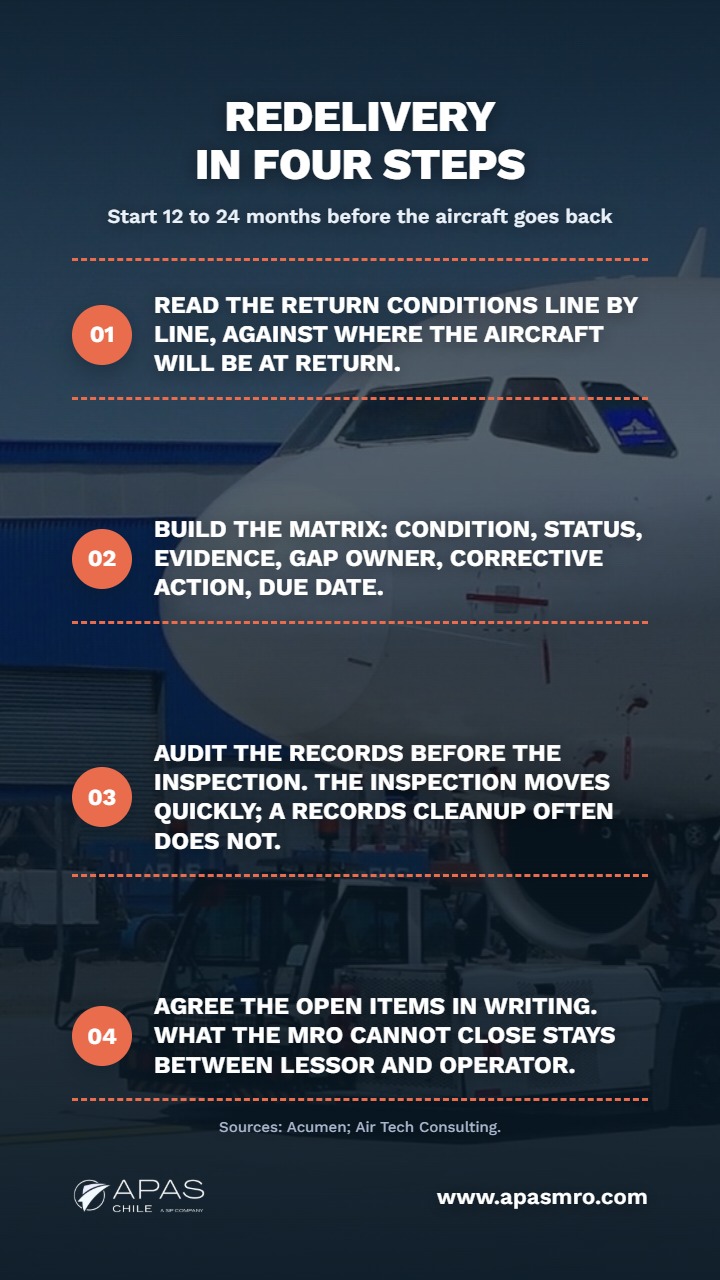
The MRO closes the technical work and signs the release. A repair station must give the owner or operator a copy of that maintenance release, as 14 CFR 145.219 requires, and that release becomes one document inside the lessor's records package.
What the MRO cannot close is the rest of the handover: reserve reconciliation, the reading of ambiguous lease wording, or commercial settlement. Those stay between lessor and operator, which is why the operator should hand the MRO three things before the aircraft arrives: the return conditions that affect the work, the current status of the records, and the list of deferred items.
When the lessor, the registry and the maintenance provider are in different countries, add one more check early: which authority's release the next registry accepts. APAS Chile works under DGAC approval CMA-655 and FAA repair station certificate APAY048E, and also holds approvals from ANAC (Argentina) and ANAC (Brazil), among other civil aviation authorities in the Americas. What those approvals mean for a fleet is explained separately.
APAS Chile's site lists documentation and redelivery support for end-of-lease or transition events among its engine shop services, and describes its bonded warehouse inside the primary customs zone at Santiago International Airport as streamlining redelivery for lessors, on the complementary services page. For the heavy work that often sits in the middle of a transition, see heavy maintenance in Santiago.
If you are planning a redelivery and want to know what a maintenance provider can close before the aircraft goes back, Start Your MRO Planning Session with your return conditions in hand.
It is the set of inspections and records reviews that prove an aircraft meets the condition its lease requires on the day it goes back to the lessor. The aircraft has to be airworthy, match what the contract says, and be backed by records that prove both.
Yes. Acumen points out that an aircraft can be airworthy and still fail specific lease return conditions, and that vague wording such as "fair wear and tear" or "good operating condition" means different things to lessor and lessee. The contract sets the standard, not the maintenance manual.
Advisers put the start between 12 and 24 months before redelivery, with the contract first and the records next. According to Acumen, inspection planning, MRO slots, workscopes and records preparation should already be active around six months out.
The MRO closes the technical work and signs the release, and under 14 CFR 145.219 a repair station must give the owner or operator a copy of that maintenance release. Reserve reconciliation, the reading of ambiguous lease wording and commercial settlement stay between lessor and operator.
It is the operator's control document for the transition, built before the physical inspection begins. Air Tech Consulting recommends six columns: the contractual return condition, the current aircraft status, the evidence available, the gap owner, the corrective action and the due date.
Our AOG response team is standing by 24/7 to source, quote, and dispatch the components you need.
Request a Quote Now