Physically Finished, Not Released: Why Aircraft Stay Down
An aircraft can be mechanically done and still not be released. Seven kinds of open items hold it, each with an owner who can close it before the last day.
A certificate of release to service is the signed statement that closes a maintenance visit. Until someone authorized signs it, work that is physically complete still counts as unfinished for every schedule that depends on the aircraft.
The aircraft ground time pillar explains why a release date is committed before anyone has seen inside the aircraft. This article covers the third way a visit overruns: the work is done, the aircraft is on the hangar floor, and it still cannot leave.
What does a certificate of release to service certify?
It certifies the work that was done, not the whole history of the aircraft, and it carries a personal signature. Under US rules, whoever maintains an aircraft must enter in its records what was done and when. If the work was satisfactory, the person who approves it signs with their certificate number. That signature is the approval for return to service for the work performed only, according to 14 CFR 43.9. A repair station must also give the owner or operator a copy of the maintenance release, as 14 CFR 145.219 requires.
The European Part-145 rule asks for the same thing in other words. In the version published in the UK CAA regulatory library, authorized certifying staff issue the certificate once they have verified that all the maintenance ordered was properly carried out, with no known non-compliance that endangers flight safety.
In practice, the person holding the pen needs complete evidence behind it. A release is also only as wide as the approvals of the organization that signs it, which is the subject of what an MRO does and who decides the work. APAS Chile releases work under DGAC approval CMA-655 and FAA repair station certificate APAY048E, and what those approvals mean for a fleet is covered separately.
What holds a finished aircraft in the hangar?
In its October 2026 issue, AviTrader MRO 360° asked six aviation professionals what keeps a physically finished aircraft from returning to service. One of them says it is rarely one big problem. It is several small open items spread across departments, and many of them are "about information rather than work."
The items they name overlap a great deal. Task cards completed but never formally closed. Non-routine findings without a closed disposition. Missing sign-offs and certificates not filed with the job. Paperwork for a replaced component, such as a release certificate or serial-number record. Airworthiness Directive and Service Bulletin compliance records. Deferred defects waiting for the customer to accept them. Engineering approvals still pending. Final checks, such as an engine run or a test flight, that were never put in the plan. Certifying staff who are not at the station when the aircraft is ready. One participant sums up the result: a mechanically complete aircraft stays grounded until the documentation catches up.
Who holds the evidence, and when should each item close?
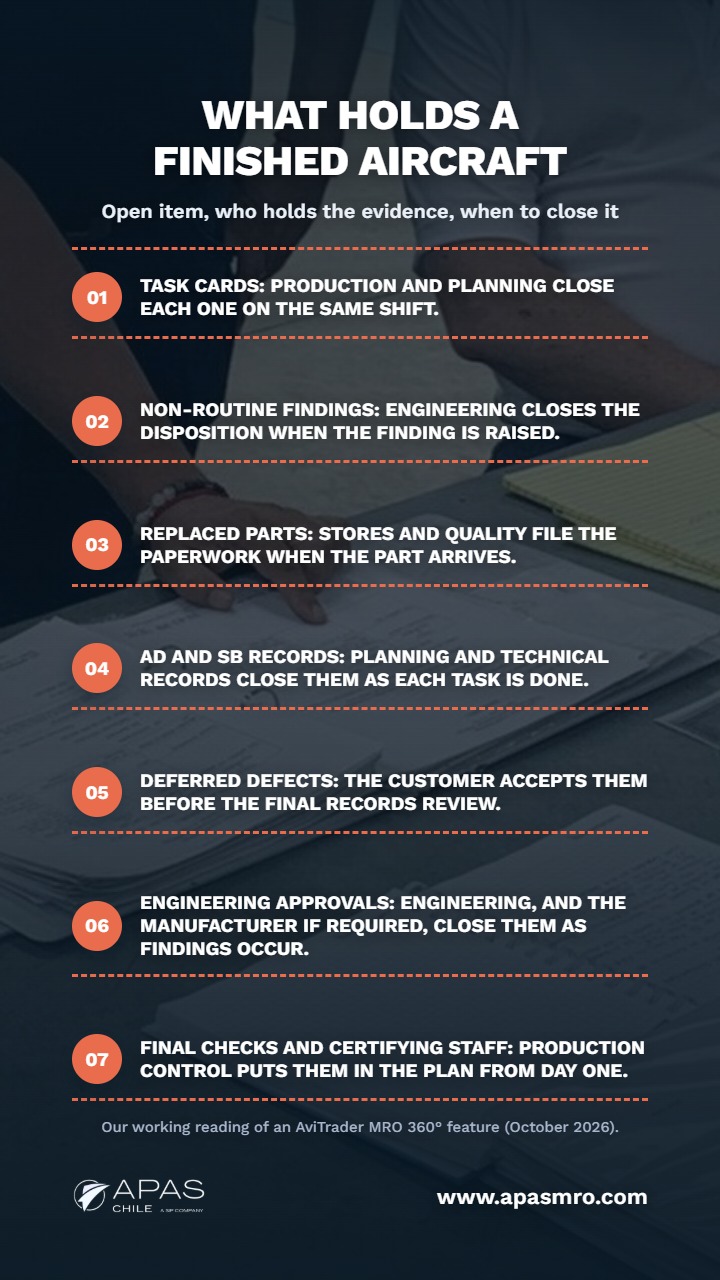
The table is our working reading of those answers, not a list taken from the feature. For each open item it shows who normally holds the evidence, when it makes sense to close it, and what a customer can ask to see every day. It is not the procedure of any one provider.
Open item
Who holds the evidence
When to close it
What the customer sees each day
Task cards finished but not formally closed
Production and maintenance planning
As each card is completed, on the same shift
Open and closed cards by zone
Non-routine findings without a closed disposition
Engineering
When the finding is raised, not at the end of the visit
Findings list with status and owner
Paperwork for replaced components
Receiving, stores and quality
When the part arrives, before installation
Parts installed against documents on file
AD and SB compliance records
Maintenance planning and technical records
As each task is performed
Compliance status of every due item
Deferred defects awaiting customer acceptance
Customer technical team, with MRO planning
Before the final records review
Deferred items that need a customer decision
Engineering approvals and approved repair data
Engineering, and the manufacturer when required
As findings occur
Pending approvals with date and owner
Final checks and certifying staff
Production control
Scheduled in the plan from the first day
Engine run or flight slot, and who will sign
Why does the gap open at the end of the visit?
Because it is not created at the end. As one participant notes, a heavy check can involve thousands of task cards, planned and unplanned, and in that participant's experience each department tracks its own part of them. The full picture often appears only when the aircraft is ready to leave. By then, the technician who could fix a missing entry may already be working another aircraft or another shift.
Another participant puts it directly: "In many cases, these aren't problems created at the end of the check, they are issues that weren't fully resolved earlier in the process."
What changes when records close every day?
Three habits come up in the answers. Maintenance planning reviews the records daily and closes them continuously. The customer receives the documentation package every day for review and validation, and open tasks are reported more often as the visit nears its end. A records audit is completed before the planned release date.
The gain is that a missing signature found on day twelve goes back to someone who still remembers the job. Found on the release date, it goes to someone who has left the aircraft.
What should you ask before committing a slot?
Ask any provider three things about the release:
How often are records reviewed during the visit, and by whom?
What does the customer receive each day: a status count, or the documents themselves?
Which certifying staff will sign, and will they be on the station on the planned release date?
Does a release to service cover the whole history of the aircraft?
No. Under 14 CFR 43.9, the signature of the person who approves the work is the approval for return to service for the work performed only. A repair station must also give the owner or operator a copy of the maintenance release, as 14 CFR 145.219 requires.
Who issues a certificate of release to service?
Under the European Part-145 rule, as published in the UK CAA regulatory library, authorized certifying staff issue it once they have verified that all the maintenance ordered was properly carried out, with no known non-compliance that endangers flight safety. Under US rules, the person who approves the work signs the record with their certificate number.
Why does an aircraft stay in the hangar after the maintenance is finished?
One of six aviation professionals interviewed by AviTrader MRO 360° in October 2026 says it is rarely one big problem but several small open items spread across departments. The items they name include task cards never formally closed, findings without a closed disposition, missing sign-offs and component paperwork, AD and SB compliance records, deferred defects, pending engineering approvals, unplanned final checks and certifying staff who are not at the station.
What helps prevent release delays at the end of a check?
Closing records every day instead of at the end. The habits named in the AviTrader MRO 360° answers are a daily records review by maintenance planning, a documentation package sent to the customer every day for review and validation, and a records audit completed before the planned release date.
Need Critical Parts Support—Now?
Our AOG response team is standing by 24/7 to source, quote, and dispatch the components you need.